
Moving from Dubai to Miami - an expert review of two metropolises
Moving from Dubai to Miami isn’t just a change of country — it’s a shift between two distinct waterfront lifestyles. On one side, there’s Dubai — known for its high level of service, safety, and global connectivity. On the other hand, Miami offers the Atlantic Ocean, a greener environment, U.S. legal and financial systems, and a different pace of everyday life. In this article, we’ll look at what this move actually means in practice. How does the climate compare? How convenient is the infrastructure? What about safety, travel, and real estate options? If you’re trying to understand whether Miami fits your lifestyle, family needs, or investment goals, this comparison will help you see the differences clearly — not in general terms, but through specific, practical advantages.

9.04.2026

15 minutes

May 21, 2026
💬 Expert Opinion of Bonadomus
Against the backdrop of global shifts and growing attention to stability, mobility, and quality of life, more people are carefully evaluating international living options. While we follow developments worldwide — including in the Middle East — this article intentionally focuses less on the reasons behind relocation and more on the practical comparison itself. Here, we take a balanced look at Dubai and Miami — helping you understand which lifestyle, environment, and real estate approach may suit you best.
Briefly about moving from Dubai to Miami — what’s important to understand right away
If you’re used to the warm climate, international environment, and globally connected lifestyle of Dubai, then Miami can feel like a natural next step. There’s no traditional winter here, the international presence is strong, premium real estate is well developed, and overall logistics are convenient.
At the same time, Miami offers something different — more natural surroundings, a stronger connection to the ocean as part of everyday life, and access not just to South Florida, but also to the broader U.S., the Caribbean, and Latin America.
- water not just as a backdrop, but as part of daily living;
- neighborhoods with distinct character;
- more greenery;
- a more varied residential environment;
- flexibility in choosing real estate — whether for primary living, a second home, or capital diversification.
💬 Expert opinion of Bonadomus
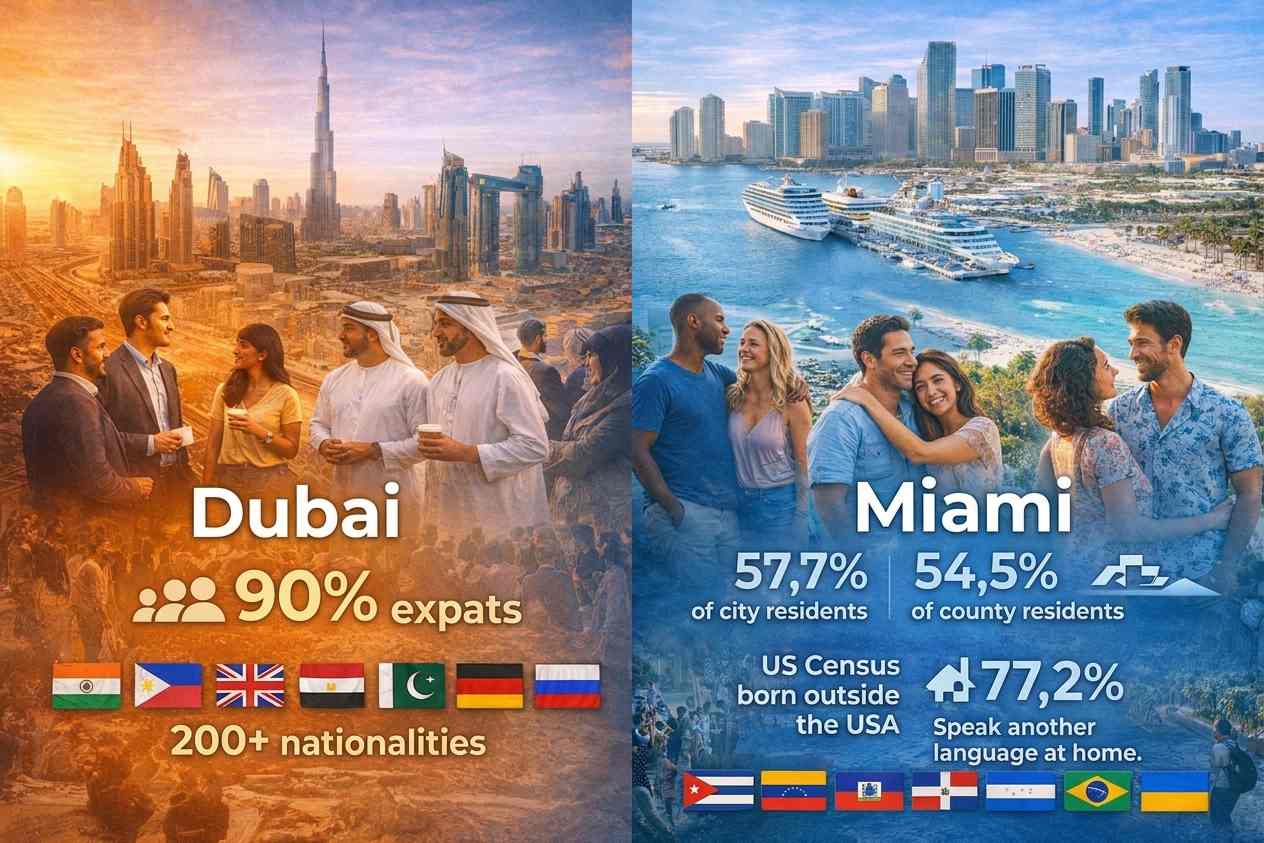
For buyers accustomed to the standards of Dubai, Miami stands out as a different format of international living — centered around the ocean, greener residential areas, and real estate that is familiar and accessible to global investors. According to U.S. Census data, 57.7% of residents in Miami and 54.5% of those in Miami-Dade County were born outside the United States, which is why many newcomers don’t experience it as a purely local environment.
Weather – In Miami, it stays warm year-round, but the climate feels different
What do they have in common?
Both Dubai and Miami are well suited for people who don’t want to return to a long, cold winter. In both cities, the climate is warm for most of the year, there’s plenty of sunshine, and daily life is shaped around the weather. For someone used to living in the UAE, moving to Miami usually doesn’t mean giving up a warm environment.
What sets Dubai apart?
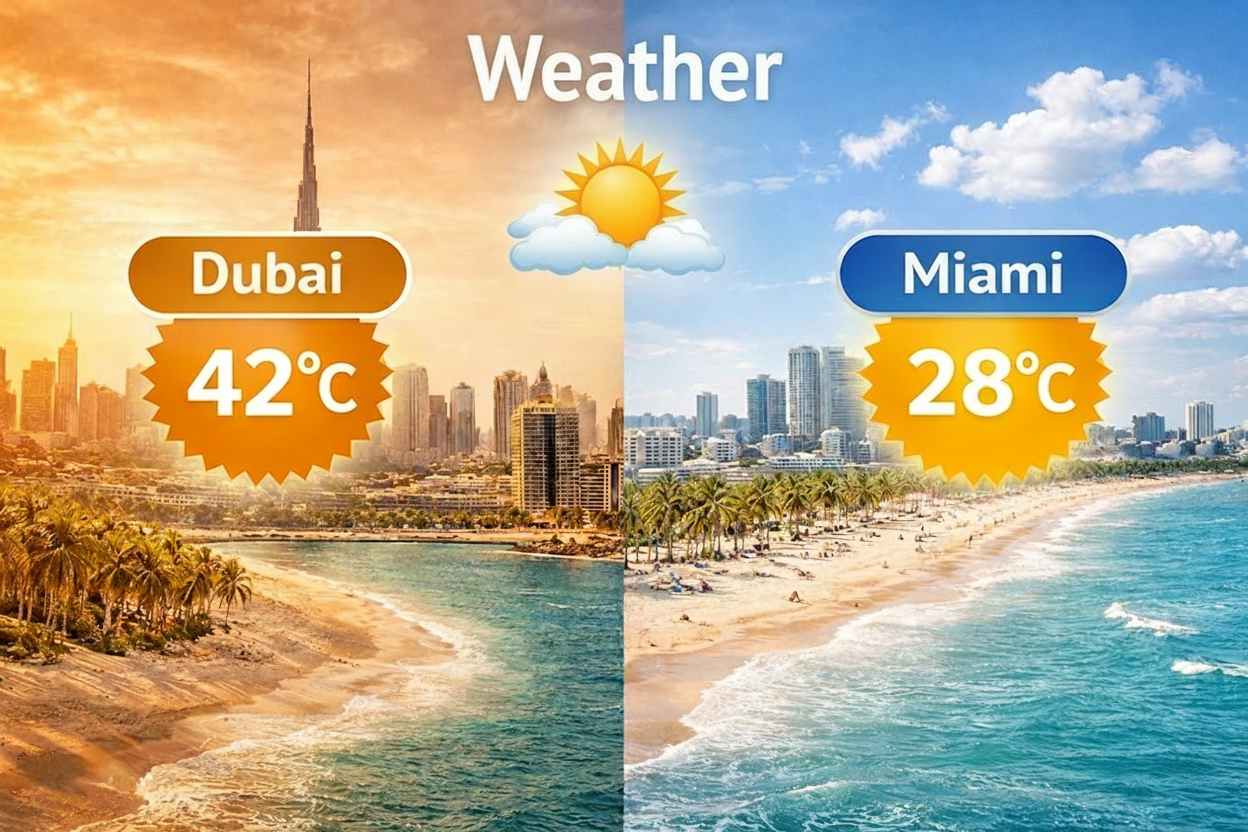
The Dubai Government Media Office notes that most days of the year are sunny. Winters are short and mild, with average daytime temperatures around 23 °C, while summer highs reach about 41.8 °C. This is a defining feature of Dubai — the climate is not just consistently warm, but often extremely hot, especially during the summer months.
What sets Miami apart?
According to NOAA/NCEI climate data for Miami Beach (1991–2020 averages), the average daytime high is 27.3 °C, the average low is 21.6 °C, and the overall average temperature is 24.5 °C. Around 138 days per year reach 32.2 °C or higher. This confirms that Miami is genuinely a very warm city — not just “southern U.S.” weather. At the same time, the climate feels different: it’s coastal rather than desert-based, with more greenery and a softer, more humid atmosphere.
What’s the takeaway for moving?
It’s less about one being “better” than the other. A more accurate way to look at it is this: if you enjoy living in Dubai without a winter season, Miami offers a similar sense of warmth — but in a greener, more ocean-focused environment, without the intense desert heat.
Infrastructure. Dubai is a cutting-edge metropolis, Miami is a comfortable residential environment with global access
What do they have in common?
Both Dubai and Miami are cities where a person with an international lifestyle does not feel disconnected from their usual rhythm. In both cases, there are business districts, a strong service environment, premium real estate, and good connectivity between housing, work, transportation, and international mobility.
What distinguishes Dubai?
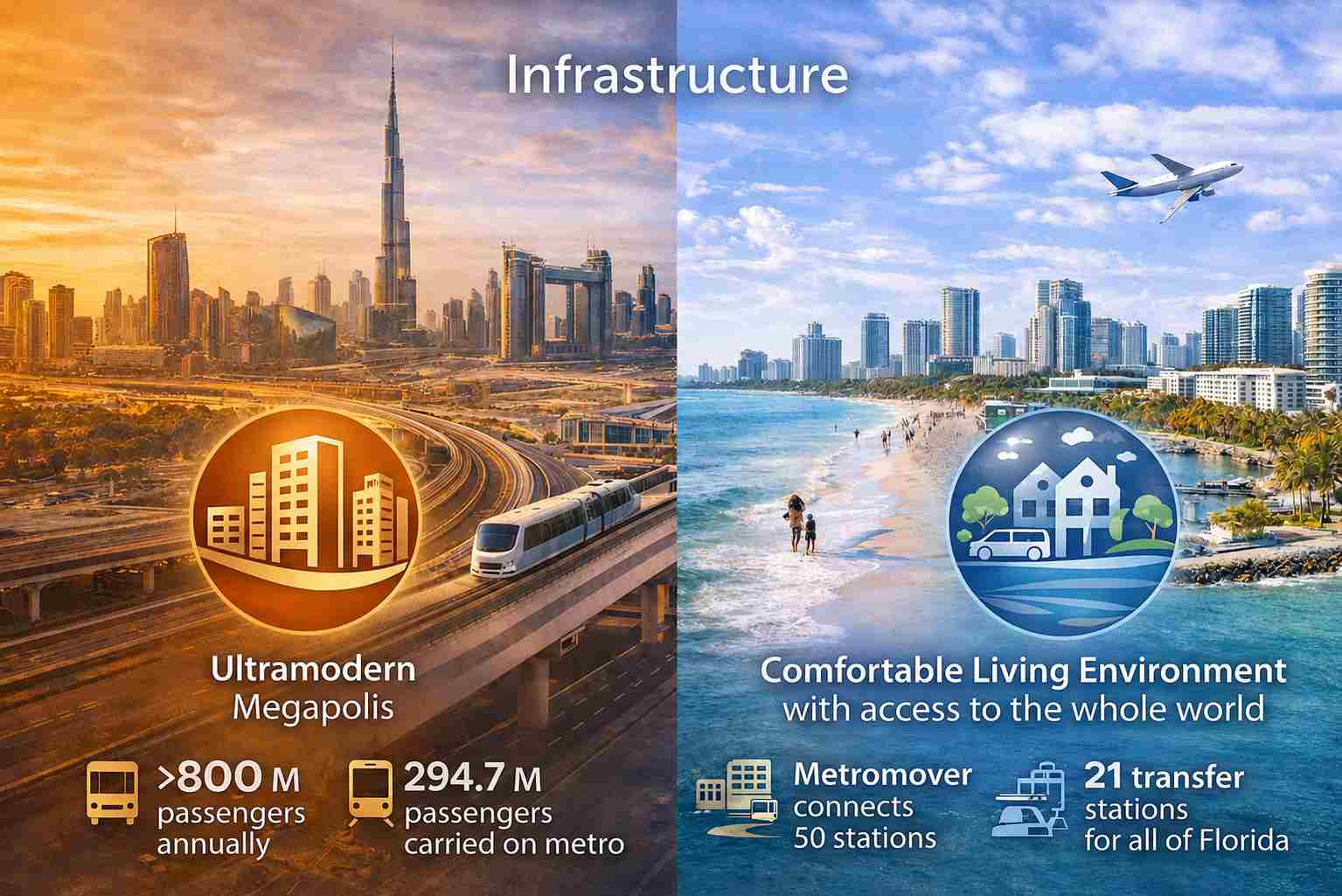
According to the Dubai Media Office, in 2025 public transport, shared transport services, and taxis in Dubai carried 802.1 million passengers, of which 294.7 million were on the Dubai Metro. This is a very strong figure for a megacity. It reflects the scale, density, and maturity of the urban transport system. That is why Dubai is perceived as a highly organized, technological, and well-managed city.
What distinguishes Miami?
Miami follows a different infrastructure logic. The official website of Miami-Dade County states that Metromover serves 21 stations. The trains connect Miami with Aventura, Fort Lauderdale, Boca Raton, West Palm Beach, and Orlando. This means that Miami is convenient not only as a city itself, but also as a base for all of South Florida and part of Central Florida.
What is the conclusion for moving?
To put it simply, Dubai is stronger as a consolidated and technologically advanced metropolis. Miami is convenient in a different way. Here, not only the urban infrastructure within the city center matters, but also the ability to quickly move between neighboring cities and key points in the region. For everyday living, this means a wider range of options — living in Miami while taking advantage of opportunities across all of South Florida.
Nature – Miami has more greenery, parks, and a sense of natural water surrounding the city
What do they have in common?
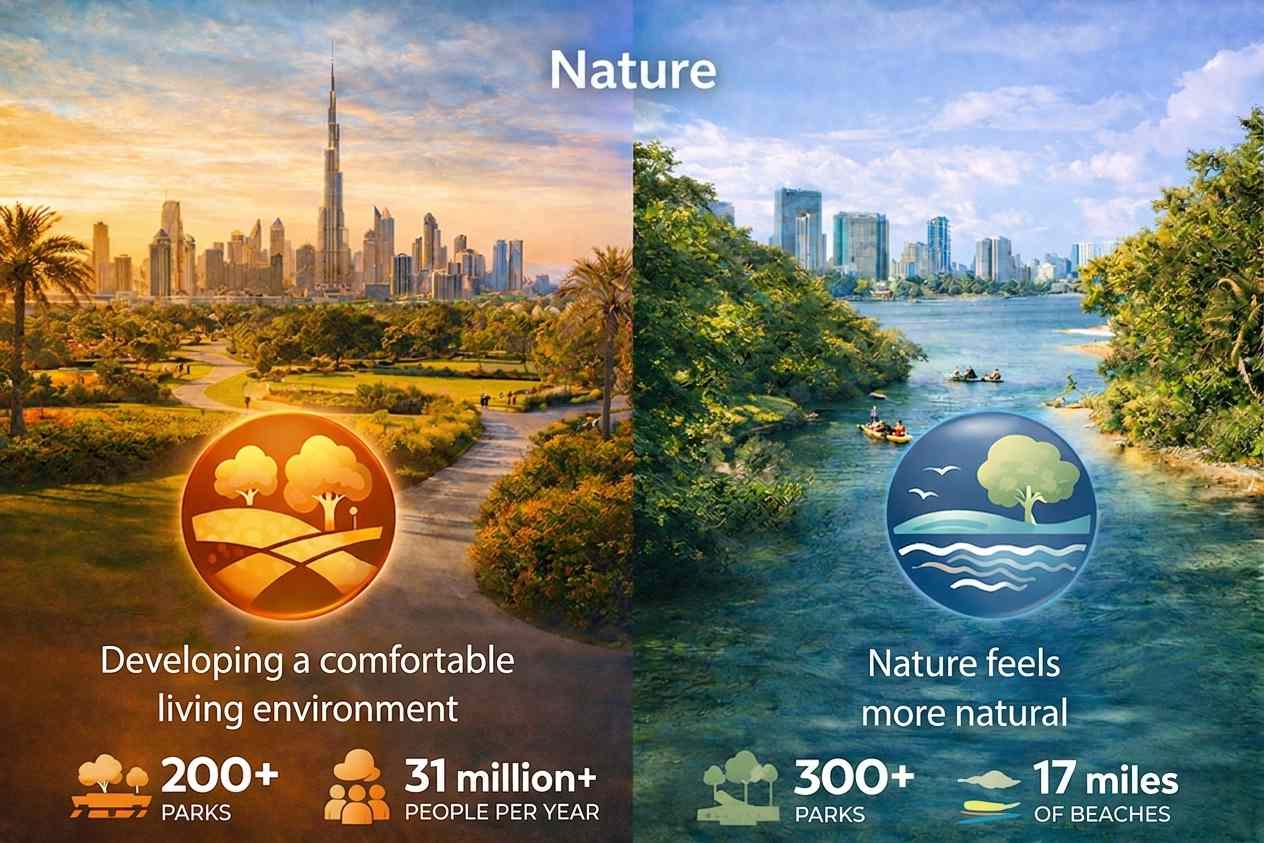
Both cities have long focused on creating a comfortable living environment through parks, waterfronts, beaches, and public spaces. In Miami, this is especially evident in the scale of the park system. The city reports more than 150 parks, while Miami-Dade County has over 300 parks and 17 miles of beaches. In Dubai, in turn, Dubai Municipality reports that in 2024 public parks were visited by more than 20.8 million people, and overall parks and recreational facilities received over 31 million visits. Additionally, more than 200 parks have already been developed in the emirate.
What distinguishes Dubai?
In Dubai, nature is more often experienced as a carefully organized part of the urban environment. This is not a drawback, but a feature of the model. The city stands out for its scale, cleanliness, technological advancement, and well-designed public spaces. At the same time, for some families, the desire for a more natural and greener environment becomes important over time. This shifts the focus from comfort to the overall character of everyday life.
What distinguishes Miami?
The City of Miami Parks and Recreation reports that the urban park system covers a total area of over 1,400 acres. This is one of the clearest official indicators explaining why Miami is perceived as a greener and more “breathing” city. Here, nature is integrated not just into occasional recreation, but into daily life and everyday routes.
What’s the conclusion for relocation?
If, after Dubai, you want to maintain a comfortable urban environment but add more natural greenery, parks, and the feeling of being near water, Miami usually responds noticeably better to this need. Neighborhoods like Coconut Grove, Coral Gables, and Key Biscayne are particularly well suited for those looking for a greener, calmer, and more water-oriented lifestyle.
Beaches – In Miami, water is not just a backdrop, but a full-fledged way of life
What do they have in common?
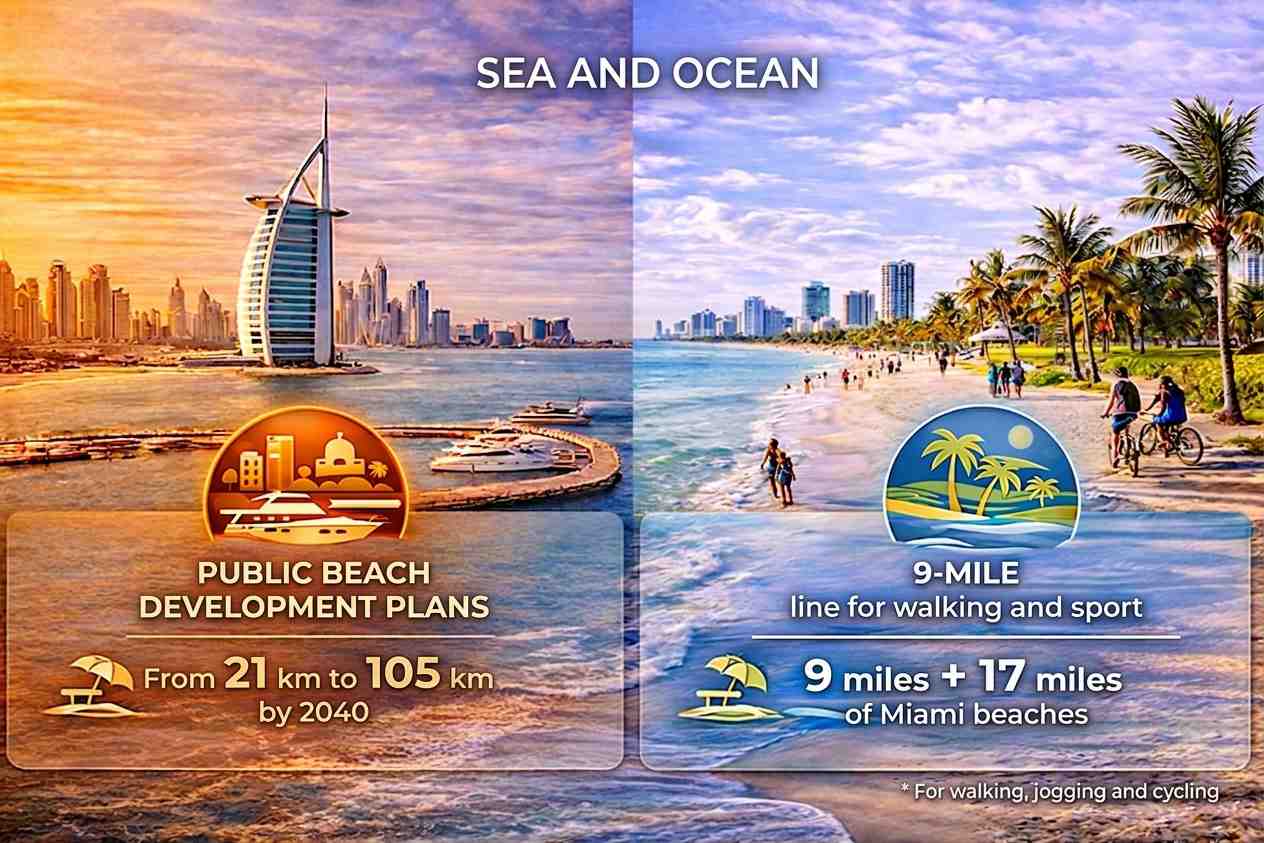
Both Dubai and Miami are connected to water and participate in the international system for assessing beach quality and coastal infrastructure (the Blue Flag program). In both cities, life by the water is no longer a rare bonus, but an important part of the urban model. Beaches, marinas, promenades, water views, and residential real estate near the shore are all part of the lifestyle. However, the nature of this water and its role in everyday life are different.
What distinguishes Dubai?
Dubai stands out in that its waterfront life is largely created and organized through major development and infrastructure projects. For example, official materials for Dock & Dine state that Dubai Harbour Marina has 705 berths, while the new Dubai Islands marina by Nakheel offers 248 water berths, 40 land berths, and the capacity to accommodate 13 superyachts at the same time. Because of this, water in Dubai is often perceived as part of a carefully designed premium urban environment — marinas, yacht zones, coastal complexes, and waterfront districts are closely tied to master planning and engineered urban logic. This is what makes Dubai’s waterfront lifestyle especially convenient, prestigious, and highly structured.
What distinguishes Miami?
In Miami, water feels different. It doesn’t just surround the city — it defines the very logic of daily life. Here, oceanfront living is not just about beaches and views, but about habits: morning runs, walks along the water, bike routes, and family weekends by the shore. Officially, Miami Beach features a nine-mile oceanfront promenade designed for pedestrians, runners, and cyclists, and Miami-Dade County maintains 17 miles of beaches to support a resort-like environment. That’s why water in Miami is perceived not as a decorative element, but as a natural part of a healthy, active, and more relaxed oceanfront lifestyle.
What is the conclusion for the move?
Moving from Dubai to Miami is not just a move “to the water,” but a transition from life by the sea to life by the ocean. In Dubai, waterfront living often feels like part of a carefully designed, prestigious, and highly organized environment, while in Miami, the water is experienced more naturally and as part of everyday life.
Relocating here allows you to maintain the habit of living near the coast, while changing the nature of that experience. Miami typically suits those who want not only a beautiful and prestigious waterfront setting, but also a more open, active, and everyday connection with the ocean — through walking, sports, family time, and the city’s rhythm.
Transport and travel accessibility – Dubai is a global aviation giant, Miami is no less a strong transportation hub
What do they have in common?
Both Dubai and Miami are cities where mobility is part of the lifestyle. They are convenient for people who travel frequently, make real estate decisions with logistics in mind, and view the city not only as a place to live, but also as a travel hub.
What distinguishes Dubai?
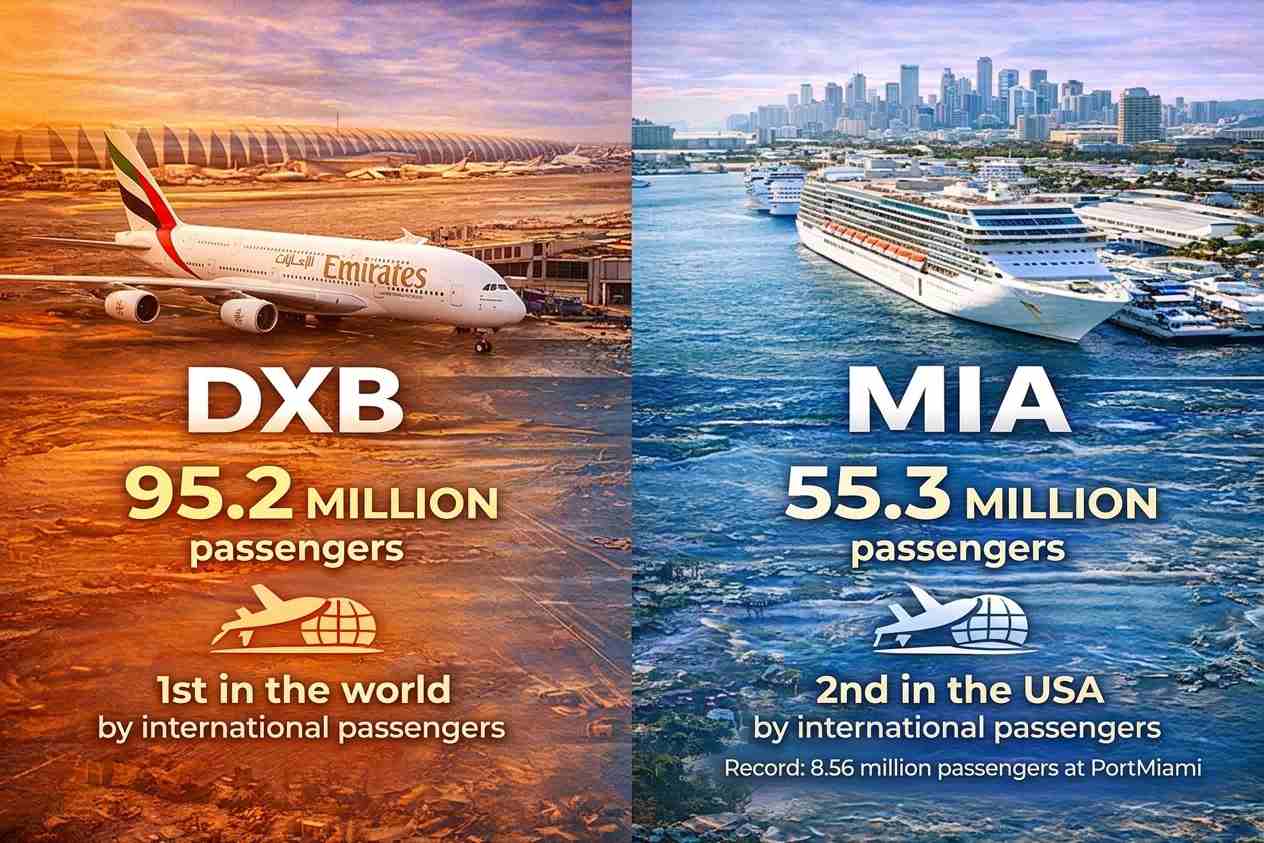
Dubai Airports reports that DXB served 95.2 million passengers in 2025 — the busiest year in its history and a global record for international passenger traffic. For people whose lives are connected with routes between Europe, Asia, and the Middle East, this is a major advantage.
What distinguishes Miami?
According to Miami International Airport, it served 55.3 million passengers, with 57 airlines operating direct flights to 190 destinations. The airport ranks second in the U.S. for international passengers based on ACI rankings. Additionally, PortMiami handled a record 8,564,225 cruise passengers in the 2025 fiscal year.
What is the conclusion for relocation?
Dubai is more strongly positioned as a global aviation hub between Europe, Asia, and the Middle East. However, this does not mean Miami is significantly behind in terms of travel convenience. On the contrary, Miami is a strong base for the U.S., South Florida, the Caribbean, and Latin America, while also serving as a major international gateway with access to virtually any part of the world.
Multiculturalism – Dubai and Miami are international, this is more noticeable in Miami
What do they have in common?
Both Dubai and Miami are international cities where the diversity of residents and languages is noticeable not only in business, but also in daily life.
What sets Dubai apart?
Dubai’s international character is largely connected to its role as a major business and migration hub. For many people, it is a city they come to for work, business, investment, and global mobility. As a result, the international environment feels like part of a large, structured expatriate ecosystem.
What sets Miami apart?
U.S. Census data shows that 57.7% of Miami city residents and 54.5% of Miami-Dade County residents were born outside the United States. Additionally, 77.2% of residents over the age of five speak more than just English at home. This makes Miami’s international character very visible in everyday life — in language, services, neighborhood culture, and daily interactions.
What is the conclusion for relocation?
In Miami, a person coming from Dubai does not lose their familiar international environment — they simply enter another version of it.
While in Dubai this environment is largely experienced through a global business and expat model, in Miami it is felt through everyday life: language, culture, services, trade, and connections with the U.S., Latin America, and the Caribbean.
For family, business, and daily living, this does not feel like a step back in international exposure — but rather a transition into a different, equally strong global environment.
Security – Dubai focuses on overall control, while Miami expands its focus on many neighborhoods
What do they have in common?
In both Dubai and Miami, safety is a key factor when choosing a neighborhood and property. At the same time, the approach to evaluating safety differs between the two cities.
What distinguishes Dubai?
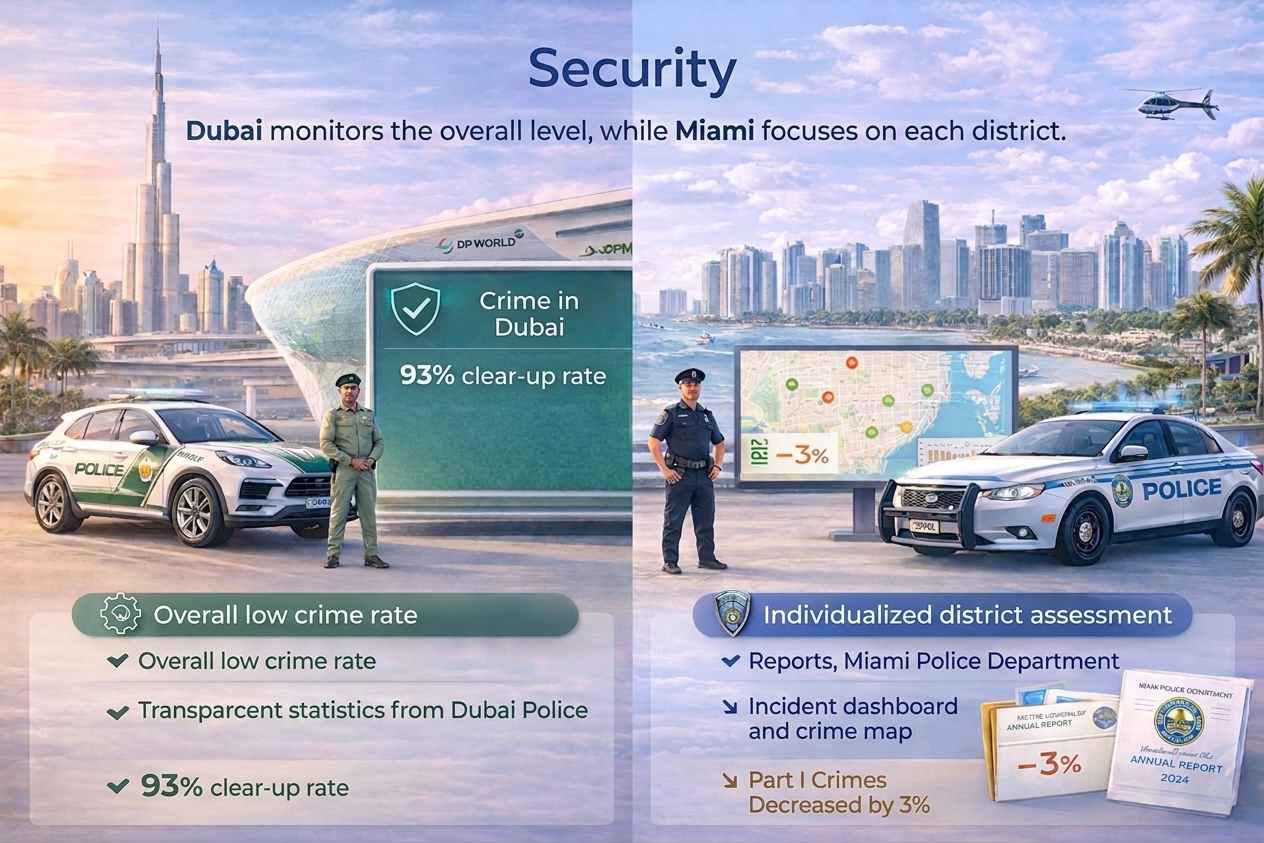
Dubai Police publish official crime indicators per 100,000 residents. The presence of transparent data, combined with the city’s overall reputation, supports a strong sense of security in everyday life. For many families accustomed to Dubai, this is one of the city’s strongest advantages.
What distinguishes Miami?
In Miami and Miami-Dade County, safety is more accurately assessed not at the city level, but at the level of specific neighborhoods and municipalities. Official tools include crime maps and statistical dashboards maintained by local authorities, while individual cities publish their own reports. For example, the Miami Police Department reported a 3% decrease in Part I crimes in its 2024 annual report. This creates an important distinction. In Miami, the question is usually not “Is the city safe?” but “How well does a specific neighborhood fit your expectations for safety and lifestyle?”
What conclusion for relocation?
For someone moving from Dubai, safety in Miami is primarily about choosing the right neighborhood, property type, and daily logistics. If privacy and a calmer environment are priorities, areas such as Aventura, Coral Gables, Key Biscayne, Sunny Isles, and Coconut Grove are often considered. Final decisions are typically made after reviewing official data and evaluating the location in person.
Diversity of real estate – Two centers for lifestyle organization
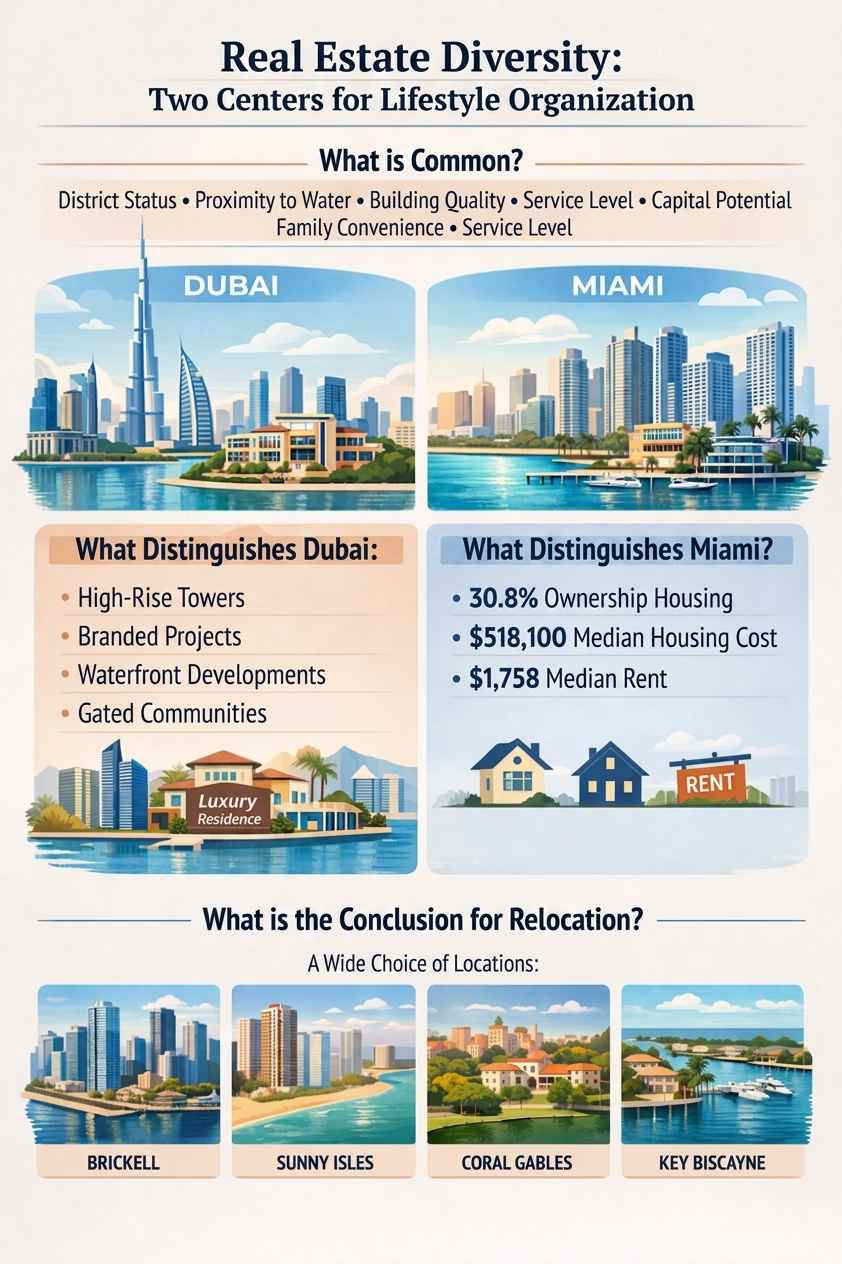
What do they have in common?
Both Dubai and Miami appeal to buyers who are choosing not just housing, but a lifestyle — including neighborhood status, building quality, proximity to water, level of service, capital potential, and family convenience. In both cities, real estate is not just square footage, but a way to structure your life.
What distinguishes Dubai?
In Dubai, many buyers are used to high-rise towers, branded residences, waterfront developments, and master-planned communities with managed infrastructure.
This is a clear, structured premium market model and often serves as the reference point for buyers from the UAE when considering property abroad.
What distinguishes Miami?
According to U.S. Census data, the homeownership rate in Miami is 30.8%, with a median property value of $518,100 and a median gross rent of $1,758. This reflects an active, urban, and investment-driven market. In addition, MIAMI REALTORS reports that international buyers accounted for 49% of purchases in new developments, under-construction properties, and newly marketed condominium inventory over an 18-month period ending June 2025. This is a strong signal that the market is highly adapted to international demand.
What is the conclusion for relocating?
The strength of Miami is not in replicating the Dubai market.
Its strength lies in offering a wider range of lifestyle scenarios within one city: an apartment in Brickell, oceanfront living in Sunny Isles, family-oriented neighborhoods like Coral Gables, the atmosphere of Coconut Grove, or more private settings in Key Biscayne.
For buyers from Dubai, Miami is often appealing precisely because of this diversity — not because it mirrors what they already know.
Comparative table for those planning a move from Dubai to Miami
|
Criterion |
Dubai |
Miami |
Brief summary |
| Weather | Very sunny, around 23 °C in winter, average highs around 41.8 °C in summer | Warm year-round, average temperature around 24.5 °C, milder coastal climate | Both cities are warm, but Miami feels softer and more natural |
| Infrastructure | Highly organized, technology-driven metropolis with a powerful transport system | Comfortable living environment with convenient regional connectivity | Dubai is stronger as a metropolis, Miami as a livable city with broader regional access |
| Nature | Well-structured urban environment, parks integrated into infrastructure | More greenery, parks, beaches, and a stronger natural feel | Miami better meets the demand for a greener, more “alive” environment |
| Sea and ocean | Waterfront life shaped through development and infrastructure | The ocean is part of everyday life — sports, walks, family time | Dubai is more structured and status-driven; Miami is more natural and everyday |
| Transport and travel | One of the world’s largest aviation hubs, especially strong between Europe, Asia, and the Middle East | Major international hub with strong U.S., Caribbean, and Latin America connectivity + cruise access | Miami is not significantly behind in mobility |
| Multiculturalism | International environment shaped by business and the expat model | International character visible in everyday life, language, and services | In Miami, international life is more embedded in daily experience |
| Safety | Strong overall sense of safety at the city level | Safety assessed by specific districts and municipalities | Miami requires more location-specific selection |
| Real estate | Clear premium model: towers, branded projects, waterfront complexes | Broader range: urban, oceanfront, family-oriented, and private formats | Miami stands out for diversity, not replication |
| General relocation scenario | Familiar structure, service level, and global mobility | Same level of internationality, but greener, more coastal, and less rigid | Moving to Miami is a shift in lifestyle format, not a downgrade |
What else is important to consider before moving from Dubai to Miami?
1. Taxes
2. Purpose of property acquisition
3. Location selection
Miami’s strength lies in combining several key advantages: the ocean, an international environment, strong transport connectivity, green areas, and a transparent real estate market.
At the same time, before moving, it is important to clearly define your goal:
permanent residence, a second home, or an investment property.
This directly affects the choice of neighborhood, tax implications, and overall purchase strategy.

Who is best suited for a move from Dubai to Miami?
1. Families who value the ocean, greenery, and an international environment
2. Buyers looking to combine lifestyle and real estate
3. Investors seeking diversification in the U.S.
4. Those who want to keep a global lifestyle but change daily experience
💬 Expert opinion of Bonadomus
If you are considering relocating from Dubai to Miami, it’s important to answer a few practical questions before making a decision. Do you need a home for permanent living, a second residence, or an investment? What matters most: oceanfront living, schools, privacy, service, profitability, or logistics? What type of property suits you — a condominium, townhouse, or standalone home? And does the chosen area correspond to your usual level of safety and comfort? In Miami, these questions usually turn out to be more important than the overall beauty of the project or the popularity of the neighborhood.
Frequently Asked Questions
Is Miami Worth Considering as an Alternative to Dubai for Relocation?
Will I lose my usual level of comfort after moving from Dubai to Miami?
Is Miami's climate similar to Dubai's?
Will it be just as comfortable in Miami for a person accustomed to the international environment of Dubai?
How convenient is Miami for international travel?
What changes in the lifestyle by the water after moving from Dubai to Miami?
Can Miami be considered a safe option for relocation?
Is there a personal income tax in Florida?
Is it possible to get a green card through real estate investment in Miami?
Why is consultation important before moving?
Official sources
- U.S. Census Bureau QuickFacts — Miami city, Florida — statistics on Miami (international composition of the population, linguistic environment, housing, and basic demographic indicators).
- Dubai Government Media Office — Geographic Location & Climate — source on Dubai’s climate (sunshine, temperature regime in winter and summer).
- Miami-Dade County Parks, Recreation and Open Spaces — analysis of parks, natural areas, beaches.
- City of Miami Beach — Beachwalk — about the nine-mile walking path along the ocean in Miami Beach
- PortMiami / Miami-Dade County — PortMiami announces a banner year for cruise passengers — about cruise passenger flow and the port’s importance to the region.
- Miami-Dade Sheriff’s Office — Crime Statistics — assessment of crime statistics by districts and municipalities
- Florida Department of Revenue — Taxes and Fees — all about Florida’s tax system and mandatory payments.