
How to Get a U.S. Green Card Through the EB-5 Investor Visa Program in 2026
A U.S. Green Card can be obtained not only through the lottery or family-based immigration, but also through the EB-5 investor visa program. This program allows foreign investors to invest in a U.S. project, create jobs, and apply for permanent residency for themselves, their spouse, and unmarried children under 21. In this guide, Bonadomus explains how the EB-5 program works in 2026, which requirements matter most, and why development projects in Florida — especially in Miami — are often considered a practical path to obtaining a Green Card through investment.

18.12.2025

19 minutes

May 12, 2026

What Is the EB-5 Program? A Simple Explanation

- You are investing in a developer’s project / a regional center;
- This money goes towards the construction of the facility and the creation of jobs;
- In return, you submit an immigration petition and, if the conditions are met, you can obtain a green card.
Important to understand
The main purpose of the EB-5 program is not to “buy a passport” or participate in a lottery, but to obtain a U.S. Green Card through investment, proper documentation, and approval of an immigration petition. Depending on the structure of the project, investors may also have the opportunity to own real estate in the United States. Bonadomus can help you explore suitable opportunities through our Miami real estate catalog.
Benefits of Obtaining a Green Card Through the EB-5 Investor Visa
Advantages
- The EB-5 visa is a direct path to a U.S. green card. One case includes the investor, spouse, and children under 21.
- It gives you the freedom to live and work anywhere in the United States.
- The possibility to apply for citizenship after 5 years of obtaining a permanent green card.
- When working through a new development in Miami, you receive not only status, but also an asset that can be rented out or resold.
Features and Risks
- the lawful source of funds has not been proven;
- the project does not meet EB-5 requirements;
- there are errors in the documents.
💬 Expert opinion of Bonadomus
EB-5 is primarily an immigration program, not a “high-yield deposit.” Minimal interest, for example around 0.5% per year on the investment amount, is a pleasant bonus, but not the goal of the program.
EB-5 Visa Requirements: Who Can Participate and Who Can Be Included in the Case
- is capable of investing no less than $1,100,000 plus fees in real Miami projects;
can provide documentary evidence of the lawful source of funds, such as:
- income from business or salary,
- sale of real estate or investments,
- inheritance,
- gifts from relatives, with confirmation of their source;
- has no serious immigration or criminal violations that would prevent obtaining status, for example, no criminal record/police clearance issues and no violations of the U.S. visa regime.
- legal spouse;
- children under 21 years of age who are not married.
💬 Expert opinion of Bonadomus
A typical investor in these cases is an entrepreneur, business owner, or co-owner; less often, a salaried top manager. What matters is not only the amount of funds, but also how transparently their origin can be demonstrated. We discuss the asset structure in advance and, together with an immigration lawyer, assess how realistic the case is.

How much does a green card cost under the EB-5 program?
| Expense Category | Amount (USD) | Comments |
| Principal Investment | $1,100,000 | Investment capital. Returned to the investor after project completion, typically within 3–5 years. |
| Administrative Fee | ~$70,000 | Project management fee and Regional Center expenses. Non-refundable. |
| Legal Fees | $30,000 – $35,000 | Immigration attorney fees, including preparation of Source of Funds and petition filing. |
| Government Filing Fees | Varies | Payment for Form I-526E and other USCIS petitions |
In total, how much does an EB-5 visa cost?
In total, you need to have approximately $1.2 million in liquid capital upfront. EB-5 projects are not about high earnings, but about capital preservation and immigration status. Usually, the developer pays about 0.5% per year on the invested amount.
Unique strategy: EB-5 visa + apartment in a new building
Regular purchase without EB-5
- when signing the contract, you usually pay 50% of the property’s cost;
- the remaining 50% is paid closer to the building’s completion — using your own or borrowed funds;
- foreign investors, even without U.S. resident status, can often obtain a mortgage with a down payment starting from 30%, although specific terms depend on the bank.
Purchase using EB-5
- You invest $1,100,000 in the project, plus administrative and legal fees.
- You inform the developer that you want to take an apartment in the same complex under special EB-5 conditions.
- Instead of a 50% down payment (as with a standard deal, without EB-5) for the apartment, you only pay 25%.
- The house is being built. After completion, you can:
- live in the apartment,
- rent it out (including short-term rental).
- After approximately 3–4 years, under the terms of the project, your investment through EB-5 is returned (plus about 0.5% per annum, if stipulated by the contract).
- You use this refunded money to cover the remaining cost of the apartment (75%).
- The apartment becomes your asset: you can sell it or keep it in your portfolio.
Comparison of Terms: Regular Real Estate Purchase vs Purchase through the EB-5 Program
| Deal Criterion | Scenario A: Regular Purchase (Non-resident) | Scenario B: Purchase through EB-5 Program (Investor) |
| Ultimate Goal | Apartment only (asset) | Green Card for the family + apartment |
| Down Payment to Developer | 50% upon contract signing | 25% under preferential EB-5 terms |
| Investment Capital | $0, paying only for the apartment | $1,100,000 frozen for 3–5 years |
| How the Balance is Paid Off | Personal funds or mortgage, often at a high interest rate | From the return of EB-5 investment principal |
| Immigration Status | Tourist visa B1/B2, up to 6 months per year | Permanent Residency (Green Card), right to work and run a business |
| Risks | Market risk (asset price) | Immigration risk (petition approval) |
| Outcome After 5 Years | Ownership of the apartment | Ownership of the apartment + U.S. citizenship option |
💬 Expert opinion from Bonadomus
What is the most profitable way to invest in real estate under the EB-5 program?
The ideal option in this case is to find a developer who will complete the project shortly after your investment. For example, if the developer hands over the property within 1–2 years, then by paying only 25%, you will be able to live in the apartment or rent it out while waiting for the return of your EB-5 investment principal and receiving your documents.
How to Start the EB-5 Process: Step-by-Step Guide
Option 1: you are already in the USA (Adjustment of Status)
- Plus: You can apply for Adjustment of Status simultaneously with the investor petition. This gives you the right to legally live in the country while waiting for a decision.
- Restriction: After submitting the documents, you cannot leave the USA for approximately 12 months (until obtaining a travel permit, Advance Parole).
Option 2: you are abroad (Consular Processing)
- You submit documents remotely.
- You can travel the world calmly and continue living in your own country.
- You can travel the world calmly and continue living in your own country.
⚠️ Important!
The second option allows you to stay on the territory of the USA for up to 6 months a year while the housing is being built. At the same time, freedom of movement to other countries is maintained. As soon as the project is completed and the deal is closed, you can immediately apply for green cards.
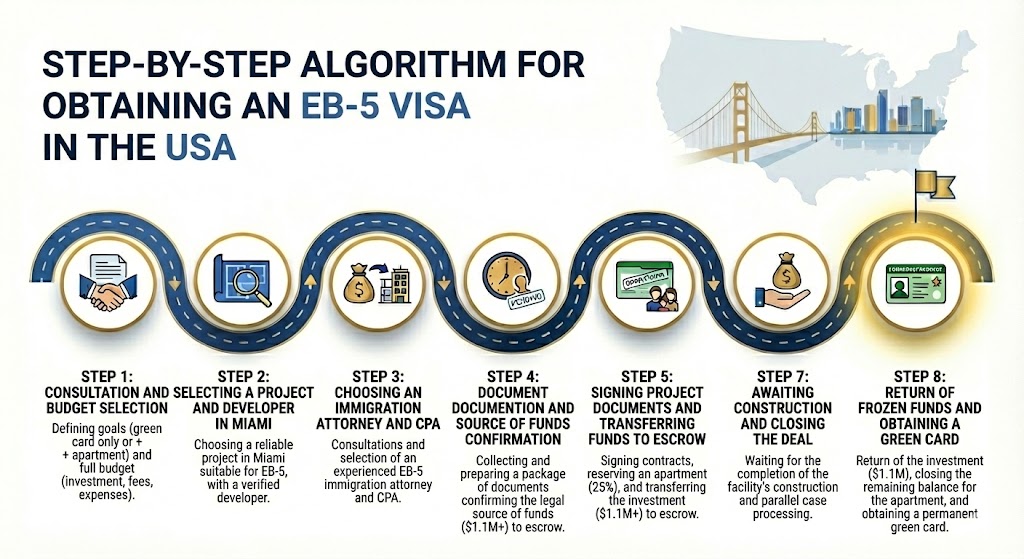
Step 1. Consultation and Budget Selection
- Discussing tasks: just a green card or a green card + apartment + rent.
- Set a realistic budget: not just the investment amount (1.05–1.1M), but also fees, taxes, lawyers, realtors.
- the investor petition (I-526 / I-526E)
- documents for status adjustment in the US or consular processing abroad
- the final petition to remove conditions (I-829)
- accompanies you during USCIS requests and at the final stages
Step 2. Selecting a project and developer in Miami
Step 3. Choosing an immigration lawyer and CPA
💬 Expert opinion of Bonadomus
We always offer clients a combination: immigration lawyer + real estate lawyer + CPA. We have the expertise, a well-established system, lawyers, and other specialists with proven reputation and experience. Thanks to this, our clients save tens of thousands of dollars and years of stress, which often happens when someone tries to “save money” only to suddenly find out that the contract or tax structure was chosen poorly.
Step 4. Preparation of documents and confirmation of the source of funds
Step 5. Signing project documents and transferring funds to escrow
- You sign a standard project contract (subscription agreement, partnership agreement, etc.). If you want an apartment, you reserve the property and pay 25%.
- The lawyer double-checks the contract and, if necessary, secures amendments (although developers often say that contracts are "not changed," a good lawyer can negotiate many things in favor of the investor).
- At the negotiation stage with lawyers and developers, the investor can change the direction of the deal, even if the preliminary contract has already been signed.
- Transfer to escrow:
- the principal investment amount, which is frozen for 3-4 years (for example, $1,150,000),
- the administrative fee (for example, $70,000),
- simultaneously pay the EB-5 attorney's fee ($30,000–35,000).
Having a knowledgeable lawyer is the key to recovering funds and protecting the client’s interests.
Step 6. Filing the I-526 / I-526E Petition
Step 7. Waiting for construction and closing the deal
⚠️ Important!
Reselling the contract before construction is completed is not allowed. Sale is possible only after the deal is closed and ownership rights are obtained. Only re-registration of the property to your own company, where the investor is the owner, is permitted.
After the deal is closed, a sale is possible immediately, but it will be subject to a high capital gains tax. After 2 years of ownership, the tax on sale will be lower. Therefore, such properties are usually rented out for short-term rentals, such as Airbnb, or placed under management, typically for 10–15% of income.
Step 8. Returning frozen funds and obtaining a green card
EB-5 Green Card for Russian Citizens: Restrictions and Real Opportunities in 2026
At the federal level, there is no specific ban on the EB-5 visa for Russian citizens. However, there are nuances that must be considered even before transferring money to the project.
Here are three points affected by the client’s possession of a Russian passport:
- State selection
- Banking compliance
- Ownership structure
State and specific property selection. For example, Florida has law SB 264, which restricts the purchase of land and real estate near critical infrastructure by citizens of “countries of concern.” In several locations, a Russian citizen simply will not be able to close the deal — even if the deposit has already been made.
There was a case where clients made a deposit but, due to the absence of a second passport other than Russian, could not close the apartment purchase because of state law. The developer returned the funds. Therefore, it is critically important to work with our team and a lawyer.
The Bonadomus team helps check in advance whether your specific Russian passport and your case can participate in a particular EB-5 project without violating state laws or federal requirements. Submit an application: together with an immigration lawyer, we will assess the risks, select a safe project, and determine the optimal real estate ownership structure.
Banking compliance. Opening accounts, passing KYC, and transferring large sums from abroad may take more time and require additional documents.
Ownership structure. Sometimes it is optimal to register the property under a company (LLC) or a family member with another passport. These decisions should be made together with an immigration lawyer and CPA.
Meanwhile, the basic requirements for a U.S. investor visa for Russians under the EB-5 program are the same as for all investors. Investment from $1,100,000, a transparent and documented source of funds, absence of serious immigration and criminal violations.
In practice, we see several typical scenarios:
- a Russian citizen with a residence permit or second passport (EU, UAE, etc.);
- family cases where ownership structure of the property is built through a company or another family member.
Why do you need a guide?
- Select a project that is not just “on paper,” but is actually being built.
- Find a Russian-speaking lawyer with successful EB-5 cases
- Coordinate communication every 4-5 years until you receive the money and green card
Questions and Answers
What is an EB-5 visa in the USA in simple terms?
How much do you need to invest for an EB-5 visa?
How is the EB-5 investor visa different from the regular E-2 visa in the USA?
What are the main requirements for an investor under the EB-5 visa?
Can Russian citizens obtain an EB-5 visa in 2025?
Submit your application to our specialists, who are always up to date with the latest legislative changes.