
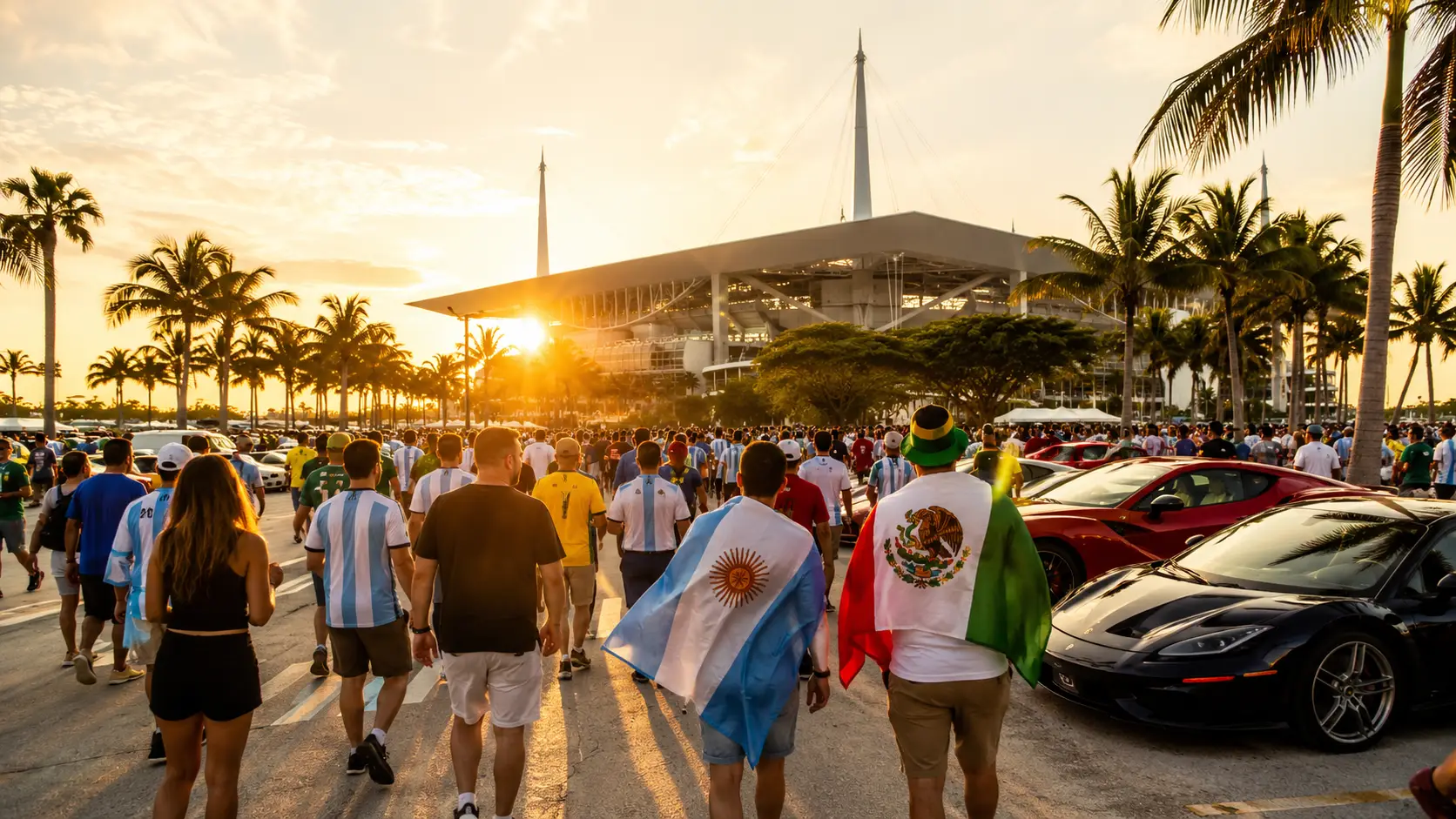
FIFA World Cup 2026 Kicks Off: Miami Prepares to Host Seven Matches of the Planet's Biggest Football Tournament
In summer 2026, Miami will host 7 FIFA World Cup matches. This event will boost tourism, international attention to the region, and stimulate South Florida's real estate market.

May 30, 2026

6 minutes

May 31, 2026
FIFA World Cup 2026 Kicks Off: Miami Prepares to Host Seven Matches of the Planet's Biggest Football Tournament
In summer 2026, Miami will be at the center of global sports attention. The city has been selected as an official host of the FIFA World Cup 2026—the largest tournament in football history. The competition will run from June 11 to July 19 across three countries: the USA, Canada, and Mexico, with the number of participating teams expanding for the first time to 48 national squads.
For South Florida, this is more than just a sporting event. The World Cup will be a powerful driver of tourism growth, international attention to the region, and an additional stimulus for the hospitality, entertainment, transportation, and real estate markets.
Miami Among the Tournament's Key Host Cities
As part of FIFA World Cup 2026, Miami will host seven official matches. Among all U.S. host cities, this is one of the most packed tournament schedules. The city will host not only group stage matches but also decisive knockout stage games.
Football matches will be held at Hard Rock Stadium in Miami Gardens. During the championship, the venue will be officially called Miami Stadium in accordance with FIFA's neutral branding requirements for stadiums.
The stadium seats approximately 65,000 spectators and has long been considered one of the premier sports venues in the United States. It has hosted Super Bowls, Copa América matches, international football tournaments, Formula 1 stages, and numerous other world-class events.
Which Matches Will Be Played in Miami
According to the published schedule, Miami will host the following FIFA World Cup 2026 matches:
- June 15 — Saudi Arabia vs. Uruguay;
- June 21 — Uruguay vs. Cabo Verde;
- June 24 — Scotland vs. Brazil;
- June 27 — Colombia vs. Portugal;
- July 3 — Round of 32 match;
- July 11 — Quarterfinal;
- July 18 — Third-place match.
Special attention is drawn to matches featuring Brazil, Portugal, Colombia, and Uruguay. These national teams have enormous international followings and traditionally attract tens of thousands of fans from around the world.
Equally significant will be the third-place match, which will take place in Miami one day before the tournament final. Such games traditionally draw massive television audiences and become part of the global sports narrative.
The Largest World Cup in History
The 2026 tournament will be the largest in World Cup history. For the first time, 48 national teams will participate instead of the usual 32. The total number of matches will increase to 104, with games held across 16 cities in three North American countries.
This expansion means a record number of tourists, fans, journalists, business representatives, and international organizations will visit host cities.
For Miami, this is especially important given its status as a global transportation hub connecting North America, Latin America, and Europe. FIFA calls Miami one of the world's most international cities, where dozens of cultures and languages coexist, and football holds a special place in city life.
The City Prepares for an Influx of Fans
World Cup matches are expected to place significant pressure on South Florida's transportation infrastructure. Local authorities and organizers are already working on spectator transportation plans to the stadium.
For ticket holders, special free shuttles are planned from key regional transportation hubs, including Brightline Aventura, Golden Glades Intermodal Station, and other transit centers.
Experts also anticipate high demand for hotels, short-term rentals, and hospitality services. Such events traditionally lead to significant increases in hotel occupancy and tourism spending in host cities.
FIFA Fan Festival and the Atmosphere of a Grand Celebration
World Cup life won't be limited to the stadium alone. One of the main attractions will be the FIFA Fan Festival at Bayfront Park.
For several weeks, the venue will host live match broadcasts on large screens, concerts, cultural events, interactive installations, and entertainment programs for residents and visitors. According to organizers, the festival area will cover over 436,000 square feet along the Biscayne Bay waterfront.
Essentially, downtown Miami will transform into an international fan zone where thousands of fans from different countries will gather daily.
What This Means for Miami's Real Estate Market
Major global sporting events traditionally influence city recognition and investment appeal. The World Cup will be another opportunity to showcase Miami to an international audience as a center for tourism, business, and premium real estate.
In recent years, South Florida has already strengthened its status as one of the most sought-after U.S. markets thanks to inflows of international capital, migration of affluent buyers, and active development of the luxury segment. Hosting the FIFA World Cup 2026 further enhances Miami's global presence.
It's no coincidence that tournament organizers and business leaders call the World Cup an event that unites sports, culture, tourism, and international investment. For several weeks, the attention of millions of viewers worldwide will be focused on Miami.
A Global Showcase for South Florida
For millions of viewers worldwide, the FIFA World Cup 2026 will be not only an introduction to football but also a large-scale presentation of South Florida itself. Television broadcasts, international media reports, and tourist flows will showcase the region far beyond the stadium.
Hard Rock Stadium is located in Miami Gardens—the northern part of the Miami-Dade metropolitan area. Historically, this area developed as a primarily residential suburb with low-rise development, wide thoroughfares, and large land parcels. However, in recent years, the area around the stadium has transformed into one of the largest sports and entertainment centers in the United States. It hosts the Miami Grand Prix Formula 1 stage, Miami Open, major music festivals, NFL games, and international football tournaments.
While residential neighborhoods and transportation infrastructure dominate immediately around the stadium, just minutes away lie neighborhoods that shape South Florida's modern image for an international audience.
One of the first destinations for tourists is Aventura—one of the most sought-after residential areas in North Miami. Here you'll find modern residential towers, yacht marinas, golf courses, luxury shopping centers, and prestigious condominiums with views of the Intracoastal Waterway. The area actively attracts buyers from Latin America, Europe, and Canada, and its real estate market is considered one of the most international in the region.
Even closer to the ocean lies Sunny Isles Beach—the famous line of ultra-luxury skyscrapers along the Atlantic coast. This is where many of South Florida's most recognizable residential towers are located: branded residences, oceanfront penthouses, serviced apartments, and complexes with private beaches. The area has long been a symbol of Miami's international luxury real estate market.
For many international fans, attending a match will be their first introduction to South Florida's architecture. Along the route from airports and tourist areas to the stadium, they'll see dozens of modern residential towers, new mixed-use projects, hotel complexes, superyacht marinas, and areas of active urban redevelopment.
Special attention in recent years has been drawn to Hallandale Beach and neighboring coastal areas between Miami and Fort Lauderdale. New residential complexes are actively being built here, and proximity to the region's sports facilities is already becoming a separate factor of investment interest. Analysts note that some buyers consider real estate precisely because of its location near Hard Rock Stadium, the future Miami Freedom Park, and other South Florida sports centers.
Simultaneously, the global audience will be shown another Miami—the center of modern skyscrapers in Downtown Miami and Brickell. These areas are today considered the city's financial and investment core. Construction continues on dozens of new luxury projects here, including branded residences from global automotive, hospitality, and fashion brands. Miami already ranks among the world's leaders in the number of branded residences, and the World Cup will further intensify international attention to this market segment.
As a result, FIFA World Cup 2026 will be for South Florida not just a sporting event, but a large-scale international showcase of the region. Millions of viewers will see modern infrastructure, oceanfront skyscrapers, new residential neighborhoods, transportation projects, tourist districts, and one of the fastest-growing real estate markets in the United States. For Miami, this is an opportunity to strengthen its status as a global city where sports, investment, tourism, and luxury real estate have long been part of a unified ecosystem.
- — Miami Among the Tournament's Key Host Cities
- — Which Matches Will Be Played in Miami
- — The Largest World Cup in History
- — The City Prepares for an Influx of Fans
- — FIFA Fan Festival and the Atmosphere of a Grand Celebration
- — What This Means for Miami's Real Estate Market
- — A Global Showcase for South Florida