Moving from Azerbaijan to the USA: what documents are needed, how the process goes, and what risks are involved?
For many families today, relocating from Azerbaijan to the United States is no longer just a dream of living by the ocean — it’s a practical step toward a more stable, predictable, and comfortable future. At the same time, turning that idea into reality comes with a lot of important questions. In this article, we’ll walk you through how the move from Azerbaijan to the U.S. actually works: the legal pathways available, the steps you’ll need to take, and the documents you should prepare. We’ll also cover where the consular stage takes place and outline the key risks it’s important to understand in advance. If you’re seriously considering this move — whether for yourself, your family, or through an investment route — this guide will help you see the full picture, from the first steps to settling in and building a life in Miami.

16.04.2026

20 minutes

May 18, 2026

💬 Expert Opinion Bonadomus
Amid shifting dynamics in the Middle East and globally, many families are increasingly considering international options that offer greater predictability, mobility, and long-term stability. We understand that every relocation is driven by different personal circumstances, so this article focuses not on emotions, but on the practical aspects of the process.
Today, moving from Azerbaijan to Miami is often seen as a structured and well-considered family decision — with a clear immigration pathway, a diverse international environment, and a strong real estate market. According to U.S. Census data, 54.5% of the population in Miami-Dade County was born outside the United States, which is exactly what makes the city feel more familiar and accessible for many new arrivals.
Can you move from Azerbaijan to the U.S. — and what does that actually involve?
Yes, moving from Azerbaijan to the United States is absolutely possible. But in practice, it means going through the U.S. federal immigration process.
There isn’t a separate immigration program for specific cities. So the first step is understanding the legal basis on which you can apply for an immigrant visa or permanent residency. Only after that does it make sense to think about where you want to live — whether it’s Miami, New York City, Chicago, Houston, or somewhere else.
This order matters more than people expect. A common mistake is trying to figure out housing first and dealing with immigration later. In reality, it’s the opposite.
You start by identifying your immigration pathway. Then you file the appropriate petition or apply through a qualifying program. After that, your case goes through consular processing. And only once you’re approved to enter the U.S. does it make sense to plan the move in detail — family logistics, day-to-day life, and housing.
Main ways to move from Azerbaijan to the U.S.
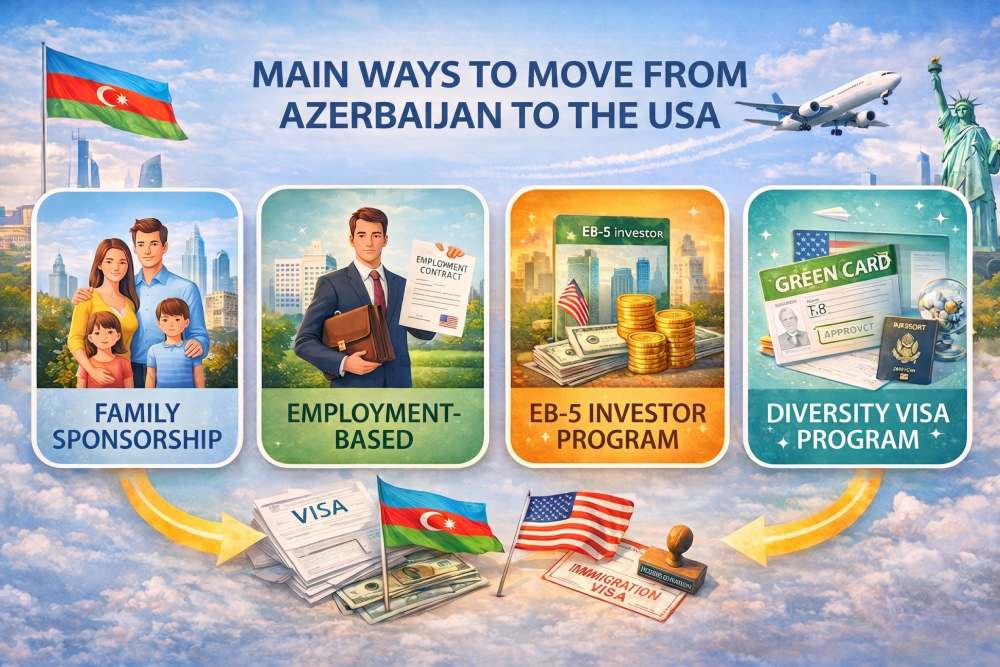
Family-based immigration
This process usually begins with filing Form I-130. It may apply to spouses of U.S. citizens, unmarried minor children of U.S. citizens, parents of U.S. citizens who meet the age requirements, and certain relatives under family preference categories.
It’s important to understand that this is not just a casual “invitation” from a relative. It is a formal immigration process where the family relationship must be proven. In many cases, the sponsor must also show financial ability to support the applicant. USCIS confirms that Form I-130 is used to establish a qualifying family relationship.
Employment-based immigration
In immigration terms, this is usually a more complex process involving Form I-140. In many cases, it also requires proof of the position, the applicant’s qualifications, and sometimes labor certification.
This is not the same as simply finding a job and moving. Employment-based immigration is a separate category, usually more suitable for skilled professionals, international company managers, people with a strong professional profile, or candidates whose employer is genuinely ready to sponsor them.
EB-5 investor program
EB-5 is a separate federal immigration process for investors. For the regional center route, it generally involves Form I-526E.
This option may be suitable for applicants who are ready to enter the process through an established investment model. Here, the investment itself is only one part of the case. The source of funds, project structure, and compliance with EB-5 program requirements are also extremely important.
Want to learn more? Read our guide on obtaining a green card through the EB-5 program.
Diversity Visa program
The Diversity Visa program, often known as the green card lottery, is a separate annual U.S. government program. Applications are submitted during a specific registration period, and participation does not guarantee selection because the process is lottery-based.
Winning the lottery also does not automatically give a person the right to move from Azerbaijan to the U.S. After selection, the applicant still needs to complete the full immigration process, including Form DS-260, document review, a medical examination, and an interview. The U.S. Department of State makes it clear that DV selection is only the beginning of the next stage, not an automatic visa approval.
How moving from Azerbaijan to the U.S. works — step-by-step process
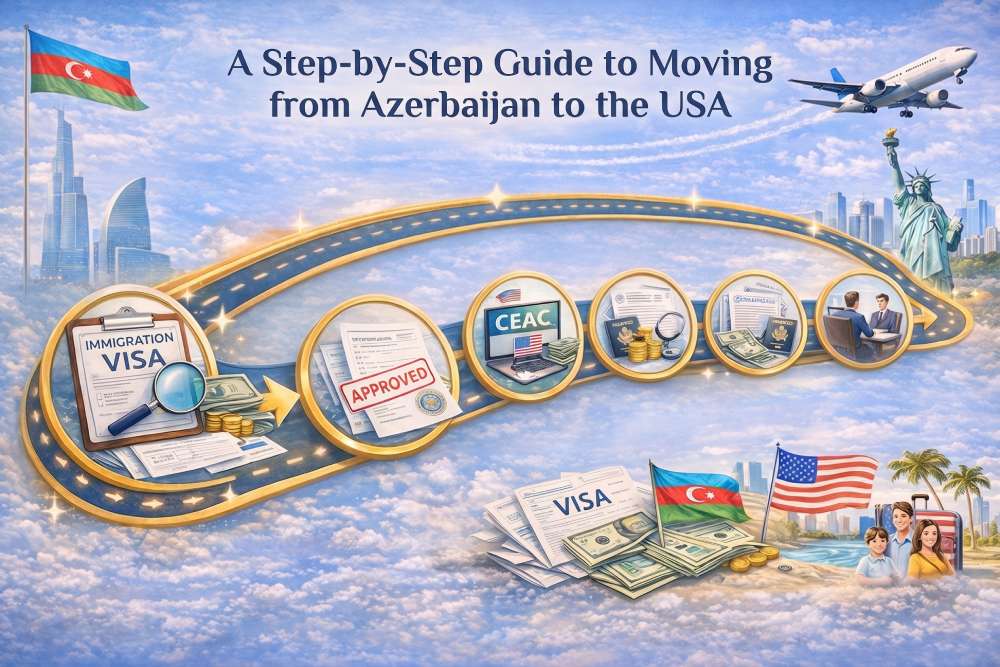
- First, the immigration basis is established.
- Then the case goes through federal processing.
- After that comes the consular stage, and only then — entry into the U.S. and the actual move, whether to Miami or another city.
Step 1. Submission of the immigration basis and case initiation
At this stage, the main document is filed — the one that officially starts the case. In family-based cases, this is usually Form I-130; in employment cases — Form I-140; in investment cases — Form I-526E; and for the Diversity Visa, the process begins with selection and a case number.
This is the point where the legal basis for moving from Azerbaijan to the United States is formally established.
Processing times at this stage depend on the category and current USCIS workload. For family cases, Form I-130 can take several months to a year or longer. For Form I-140, timelines vary by subcategory, although some allow Premium Processing, where USCIS must take action within 15 business days. For EB-5, Form I-526E is typically reviewed over many months and often more than a year. For the Diversity Visa program, timelines are tied to the visa year — the process must be completed by September 30, or eligibility is lost.
Step 2. Petition approval and case transfer
If the petition is approved, the case is transferred to the National Visa Center (NVC) for the next stage. However, in some categories, approval alone does not mean the process moves forward immediately.
This is because certain immigration categories have annual limits. Applicants may need to wait until their priority date becomes current.
This is tracked through the Visa Bulletin — the official monthly publication of the U.S. Department of State, which shows when each category can move forward.
In practice, this means that two people with similar cases may move at very different speeds. One case may continue almost immediately after approval, while another may wait months or longer — depending on the category itself.
Step 3. Working with the NVC (case registration, fees, CEAC access)
After approval, the case is transferred to the National Visa Center (NVC), which prepares immigration cases for the consular stage.
At this stage, the case is created, payments are processed, access to forms is opened, and document preparation begins.
The applicant receives instructions and works through CEAC — the online system used to pay fees, complete steps, and upload documents. Progress only continues after payments are processed.
According to official Department of State fee schedules:
- $325 — family-based visa processing
- $345 — employment-based
- $330 — Diversity Visa
- $120 — Affidavit of Support review (if required)
These are important baseline costs when planning a move from Azerbaijan to the U.S.
Step 4. Completing Form DS-260
Once fees are marked as PAID, Form DS-260 becomes available. This is the main immigrant visa application.
Each applicant, including family members, completes their own form. After submission, the confirmation page must be printed and brought to the interview.
The information in DS-260 must be accurate and consistent — it is later verified against documents and your interview responses.
Step 5. Financial review — who proves funds and when Form I-864 is required
- Form I-864 from the primary sponsor;
- sponsor's tax documents;
- confirmation of current income;
- if necessary — asset verification;
- sometimes — documents from an additional sponsor or a family member of the sponsor.
- a joint sponsor is added, that is, an additional sponsor who also submits their Form I-864;
- either the income of the sponsor's family member is used, and then Form I-864A is connected.
Step 6. Collection and Uploading of Civil Documents
After completing Form DS-260, the applicant must collect civil documents confirming identity, marital status, police history, military service (if applicable), and other relevant details. According to the U.S. Department of State, document requirements vary by country and are specified in the reciprocity schedule for each country, including Azerbaijan.
In most cases, this includes a valid passport, birth certificate, documents confirming marital status (if applicable), police certificates, military records (if applicable), and court documents if there were any legal issues.
In the standard consular process, these documents are uploaded through the CEAC system after the case reaches the appropriate stage at the National Visa Center (NVC). The sequence is important: first the case is created at the NVC, then fees are paid, then Form DS-260 is submitted, and only after that documents are collected and uploaded.
Documents not in English must be properly translated where required. In practice, incorrect translations, incomplete scans, or missing documents are common reasons for processing delays.
Step 7. Document verification and waiting for the interview
⚠️ Important!
It is not enough to simply attach files in CEAC. After uploading the documents, you need to confirm the submission, and only then will the package be placed in the review queue. If anything is missing or the documents are submitted incorrectly, NVC will send a notification, after which the package must be corrected and resubmitted.
If everything is in order, the case is considered fully prepared for scheduling an interview. This means that the fees have been paid, the DS-260 Form has been submitted, and the documents have been accepted for the next stage. However, this is not a visa issuance or final approval, but only confirmation that the document package has been accepted and the case can proceed to the interview.
After this, the NVC works directly with the relevant embassy or consulate and schedules the interview when it receives available dates. Interviews are scheduled in order, but for categories with visa limits, it is additionally important that the turn for your specific category has arrived.
According to official Department of State explanations, the NVC aims to schedule interviews within approximately three months after all documents have been accepted, but the actual time frame depends on the consulate's workload and may be longer.
Step 8. Medical Examination
Before the immigrant visa interview, the applicant must complete a medical examination with a doctor approved by the U.S. Embassy. A regular medical certificate is not sufficient. The examination must meet embassy requirements, including any required vaccinations.
The medical exam must be scheduled in advance and completed before the interview.
⚠️ Important!
Medical examination processing time may take up to 96 hours, so do not leave this step until the last moment before your interview. If the results are given in a sealed envelope, it must not be opened and should be brought to the interview. In some cases, the results are sent directly to the embassy.
What to bring to the medical examination?
A passport, the letter with the interview date, vaccination records, and, if applicable, documents related to important medical conditions. For example, for a history of tuberculosis, syphilis, psychiatric treatment, chronic diseases, or regular medication use, the applicant must have the appropriate medical documentation for the panel physician.
Step 9. Interview
⚠️ Important!
For an interview at the U.S. Embassy in Tbilisi, it is important to consider not only the documents but also organizational details. Before the trip, the applicant must comply with the requirements of the consular post itself — including completing mandatory registration related to passport issuance after the interview. Additionally, if the case is not approved immediately after the interview and is sent for administrative processing, this means an additional internal review. In such a situation, the embassy asks not to send repeated status inquiries for at least 60 days after the interview, as the decision may still be in progress during this period.
Step 10. Visa issuance, entry, and relocation
After the immigrant visa is approved, it is placed in the applicant’s passport, and entry to the United States must occur before it expires. According to the U.S. Department of State, an immigrant visa is usually valid for up to six months from the date of issue, although the validity period may be shorter if the medical examination expires earlier. For this reason, it is advisable not to delay the move after receiving the visa.
If a sealed immigrant packet is issued, it must not be opened, as this may cause problems at the port of entry.
After approval, the USCIS Immigrant Fee must be paid, as it is required for the production and delivery of the physical Green Card. If the fee is not paid, the issuance process may be delayed.
Upon entry, the applicant becomes a lawful permanent resident. The immigrant visa with an entry stamp serves as temporary proof of permanent resident status for one year.
From this point, the relocation process begins — securing housing, opening a bank account, enrolling children in school, and adapting to everyday life in the United States.
Our database includes a wide variety of housing formats in Miami: apartments, penthouses, houses, villas, townhouses, lofts, and other options depending on budget, goals, and desired lifestyle. We can show properties remotely via video call while you are still in Azerbaijan, thoroughly explain the features of neighborhoods, the pros and cons of specific locations, and also help you understand what suits you best — renting initially or buying immediately after relocation.

How long does the process take?
Overall timelines depend on several stages: USCIS processing, NVC processing, interview scheduling, and entry.
In faster cases, such as immediate relatives of U.S. citizens, the process may take several months to around a year.
- For family preference categories, wait times are often longer due to visa quotas.
- Employment-based cases vary depending on the category and processing speed.
- EB-5 cases often take over a year.
- Diversity Visa cases must be completed within the visa year.
Main risks when moving from Azerbaijan to the U.S.
- Choosing the wrong immigration basis- for example, assuming that buying property alone leads to immigration status. It does not.
- Weak financial sponsorship in family cases — insufficient income or incorrectly prepared Form I-864 can delay or complicate the case.
- Errors in Form DS-260 — inconsistencies in personal history, travel, or family details can cause issues at the interview.
- Incomplete or incorrect documents — missing records or incorrect formats can delay the process.
- Unrealistic expectations about timing — underestimating timelines can lead to logistical and financial difficulties.
What to do after arriving in the U.S.
After entering the United States, the focus shifts to practical steps. One of the first is obtaining a Social Security Number (SSN). According to the Social Security Administration (SSA), in many cases the SSN application is submitted as part of the immigration process, and the card is typically delivered to your U.S. address within a few weeks after arrival.
The next step is to monitor the payment of the USCIS Immigrant Fee and the delivery of the Green Card. After that, the process usually involves opening a bank account, securing housing, enrolling children in school, and adapting to everyday life. At this stage, choosing the right neighborhood, budget, and type of housing becomes more important than the visa process itself.
Taxes and life in Miami after moving from Azerbaijan
Miami is often attractive because Florida has no state income tax. However, federal taxes still apply, and financial planning remains important.
At the same time, Miami is a relatively expensive market.
Typical benchmarks:
average rent is around $1,800 per month,
average home value is around $460,000,
monthly mortgage-related expenses are often around $2,400,
and for fully owned homes, around $800 per month in ongoing costs.
For families, this means a clear takeaway: Miami offers an international environment and high quality of life, but requires a well-planned budget.
Frequently Asked Questions About Moving from Azerbaijan to the U.S.
Is it possible to move from Azerbaijan to the U.S. without relatives there?
Is there a separate visa for moving to Miami?
Where is the interview for relocation from Azerbaijan to the USA conducted?
How much does the consular stage cost?
Can you fill out Form DS-260 on your own?
Can you work after entering the U.S.?
What if the petition is approved but the interview hasn’t been scheduled yet?
Can you do the medical exam in Azerbaijan if the interview is in Tbilisi?
What happens if the case goes into administrative processing after the interview?
Can you move to Miami by buying property?
How much money do you need for the initial period after moving?
Can you get a Social Security Number right after moving?
Official sources
- U.S. Department of State — Azerbaijan Reciprocity Schedule — the main official source for documents specifically for citizens of Azerbaijan.
- U.S. Department of State — National Visa Center (NVC) — what the National Visa Center is, how it works, why the case goes there after petition approval, and what happens before the interview.
- U.S. Department of State — Fees for Visa Services — the official table of consular fees.
- U.S. Department of State — Form DS-260 FAQ / Online Immigrant Visa Forms — official clarifications on Form DS-260.
- U.S. Embassy Tbilisi — Immigrant Visa Instructions (TBL) — everything about the interview, practical instructions on the medical exam, police, registration, and passport issuance after the interview.
- U.S. Department of State — Visa Bulletin — the official monthly bulletin of priority dates for immigration categories.
- U.S. Department of State — Interview / Appointment Information for Immigrant Visas.