
Buying Real Estate in Miami for UAE Citizens in 2026: Documents, Taxes, Risks
For citizens and business owners in the UAE (Dubai, Abu Dhabi, Sharjah), real estate in Miami is increasingly viewed as a clear international asset within one of the most established jurisdictions in the United States. In this article, we’ll look at whether a UAE citizen can buy property in Miami, what documents are typically required, how the transaction works in practice, what tax and visa considerations exist, and what to pay attention to before transferring funds.

11.03.2026

18 minutes

May 21, 2026

💬 Expert opinion of Bonadomus
Amid rising geopolitical risks in the region, some investors and families are considering property in Miami as part of a broader strategy for capital diversification, asset protection, and creating a fallback outside the Middle East.
Is it legal for a UAE citizen to buy property in Miami?
UAE citizens can purchase real estate in Miami under the same conditions as other foreign buyers. In the United States, there is generally no federal restriction that prevents UAE nationals from buying apartments, houses, townhouses, or investment properties in Florida.
In practice, this means the focus shifts away from citizenship itself and toward other factors — such as the source of funds, deal structure, tax considerations, and legal due diligence of the property.
It is also important to note Florida law SB 264, which applies to certain countries of concern. These include China, Russia, Iran, North Korea, Cuba, Syria, and the Maduro regime in Venezuela. The UAE is not on this list, meaning buyers from the UAE fall under the standard foreign buyer framework, not a restricted category.
⚠️ Important!
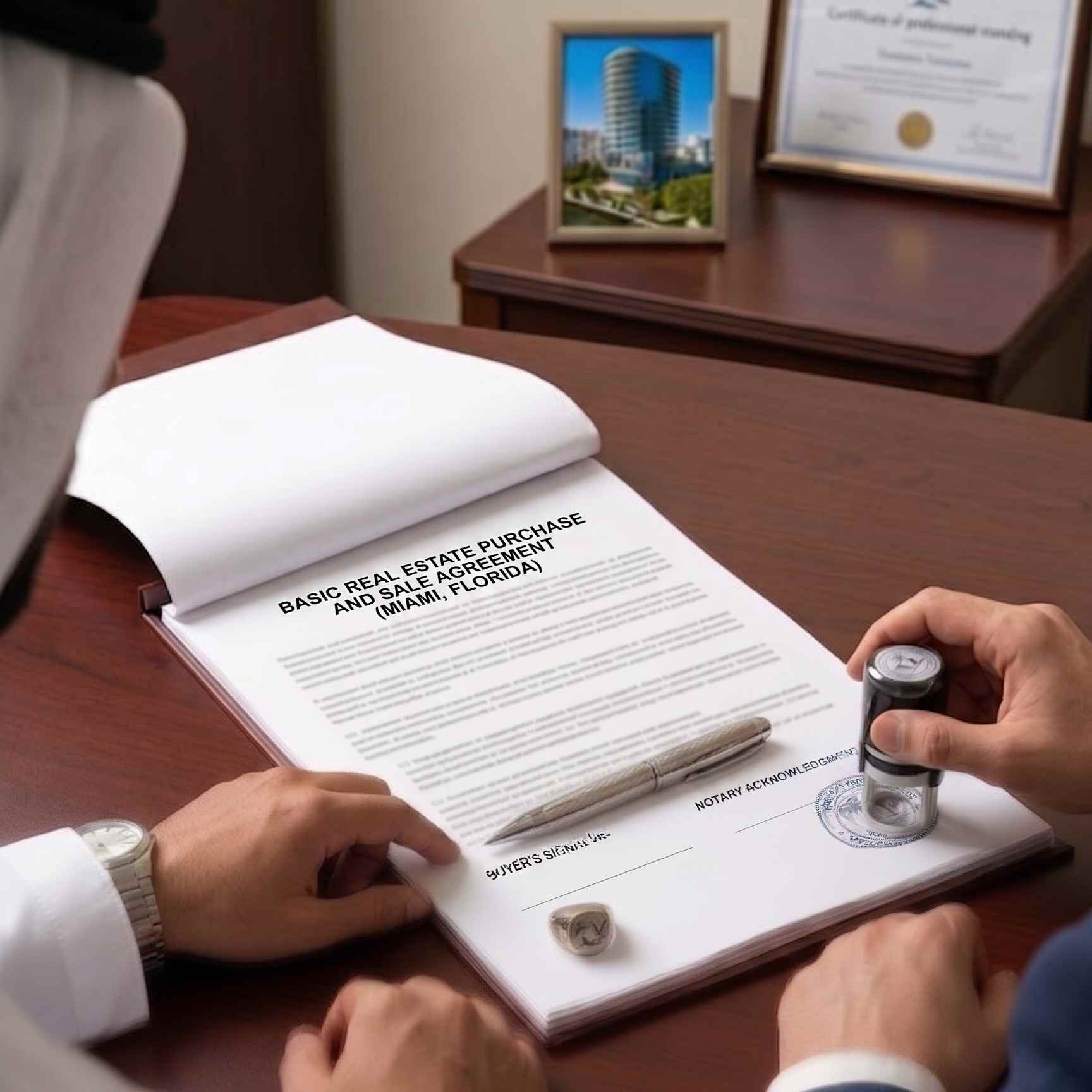
Buying real estate in the U.S. does not automatically grant a Green Card, residency, or immigration status. The structure of the transaction, tax treatment, and ownership rules depend on whether the property is intended for personal use, rental income, or resale.
Why buyers from Dubai are considering Miami in 2026
For international buyers, Miami is not only a resort destination, but also one of the most recognized real estate markets in the United States. According to MIAMI REALTORS, foreign buyers purchased $4.4 billion worth of residential property in South Florida in 2025 — higher than in 2024 — making it the largest market in the U.S. for foreign purchases.
At the same time, for buyers from the UAE, the appeal is not purely financial.
1. Urban Infrastructure and Lifestyle
Miami offers a large urban environment with walkable neighborhoods, waterfronts, parks, restaurants, sports infrastructure, and everyday services — combined with year-round warmth and coastal living.
2. International environment and family comfort
Miami is a highly international city, where many services are adapted for global residents. For families, this often means easier adaptation — language, culture, and service expectations feel familiar. For business owners, it offers a convenient base within an international network.
3. Security
Miami offers real estate formats that emphasize privacy and controlled access: concierge buildings, gated communities, secured parking, and monitored entry systems.
4. Ecology and environment
Miami combines urban life with nature — access to the ocean, waterfronts, parks, and outdoor spaces. For many, this is not just a lifestyle bonus, but part of daily life: walks by the water, outdoor sports, and time with family.
5. Flexibility as a “second home”
For buyers from Dubai, Miami property is often viewed as:
- a dollar-denominated asset
- part of international diversification
- a seasonal residence;
- a long-term family asset;
- a base for rental or hybrid use.
What documents does a UAE citizen need to purchase real estate in Miami?
It’s helpful to divide required documents into categories: for the transaction, for verifying funds, for tax purposes, and for travel (if needed).
1. Documents for the deal itself
Typically required:
- passport;
- full identification details;
- contact information;
- documents for contract preparation;
- proof of address (depending on compliance requirements);
- if purchasing through a company — corporate documents.
2. Proof of funds and source of capital
Depending on the case:
- bank statements;
- bank reference letter;
- asset sale documentation;
- proof of business income;
- financial statements;
- other documentation confirming lawful origin of funds.
⚠️ Important!
The exact list depends on the bank, title company, ownership structure, and transaction specifics.
3. Tax-related documents
An ITIN may be required if there is a U.S. tax reporting obligation. The IRS confirms that Form W-7 is used to obtain an Individual Taxpayer Identification Number for individuals who are not eligible for an SSN.
4. Documents for travel to the U.S.
There is no “real estate visa.” However, if the buyer plans to travel for viewings or signing, valid entry status is required.
For UAE citizens, B-1/B-2 visas allow multiple entries with long validity. E-2 visas are not generally applicable, as there is no treaty between the U.S. and the UAE.
How buying real estate in Miami works — step by step
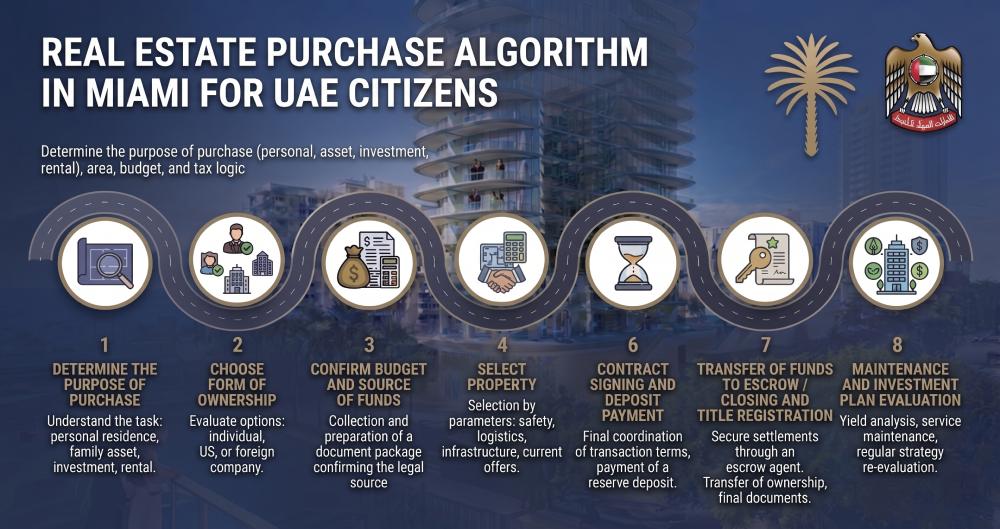
Below is the basic logic usually followed when purchasing real estate in Miami for a foreign buyer. The list of documents and the number of steps may vary depending on the type of property (condo/house), payment method (cash/financing), ownership form, and the requirements of the bank/closing team.
Step 1. Define the purchase goal
Determine whether the property is for:
- personal residence;
- family ownership;
- investment;
- rental;
- long-term holding.
This directly influences location, property type, budget, and tax approach.
Step 2. Choose the ownership structure
The purchase may be made:
- in an individual name;
- through a U.S. company;
- through a foreign entity;
- or through another structure depending on the objective.
This decision depends on tax strategy and long-term plans.
Step 3. Confirm budget and source of funds
Before entering a deal, it’s important to clarify:
- available funds;
- transfer method;
- readiness of supporting documentation;
- potential banking restrictions.
Common documents:
- Proof of Funds letter.
- statements.
- income or asset documentation.
Step 4. Select the property
Selection is based on:
- location;
- property type;
- building characteristics;
- infrastructure;
- complex rules;
- rental potential;
- long-term liquidity.
Current real estate listings in Miami.
Key considerations for UAE buyers:
- safety of the area;
- logistics;
- flexibility of use;
- property status;
- family suitability.
Documents that appear at this stage:
- Preliminary terms / term sheet (not always a formal document).
- Sometimes reservation / holding deposit agreement (especially in new buildings, depends on the developer).
Step 5. Conduct Due Diligence
One of the most critical stages. Review:
- title;
- HOA rules;
- rental restrictions;
- property history;
- possible restrictions;
- contract terms;
- developer reputation (if applicable).
Key documents:
- Title Commitment.
- HOA/Condo documents.
- Estoppel Certificate.
- For houses: - survey (plan/boundaries of the plot — when required).
- insurance feasibility

Step 6. Sign the contract and make a deposit
At this stage:
- terms are finalized;
- deposit conditions are defined;
- payment procedures;
- timelines and obligations are agreed.
The main document is the Purchase and Sale Agreement with addenda. + Addenda (attachments: inspection, condo/HOA, deadlines, special conditions). This is where deadlines, deposits, exit conditions, and the parties' responsibilities are recorded.
Step 7. Transfer funds (escrow)
Funds are typically held in escrow, not transferred directly to the seller.
Documents may include:
- escrow instructions
- ALTA settlement statement.
- closing disclosure (if financing is involved).
Step 8. Closing and ownership registration
Final stage:
- payment completed
- documents signed
- ownership transferred and recorded
Accuracy of documentation is critical, especially for foreign buyers.
Step 9. Actions after the deal
After closing:
- insurance setup
- property management
- utility setup
- rental setup (if applicable)
- expense and document tracking
Additional forms (if needed):
- ITIN (Form W-7)
- FIRPTA forms (8288, 8288-A, 8288-B for future sale)
How long does it take to purchase real estate in Miami for UAE citizens?
There is no universal single timeframe because it depends on the type of property (resale or new build), payment structure (cash or mortgage), speed of document verification, seller's conditions, and contract specifics. However, in residential real estate transactions, the following ranges can usually be used as a guideline:
- Ready property (resale), cash payment: usually from 21 days, if there are no complex checks and all parties quickly exchange documents. Typical ranges:
- Completed property (resale), purchase with financing (mortgage): typical range 30–45 days, in some cases 30–60 days (if appraisal, additional approvals, and checks are required).
- New building / pre-construction: here it is often not about “30–45 days,” but about the period from the contract to the actual completion of the project and closing — usually 12–30 months for small projects and 18–48 months (sometimes longer) for high-rise and complex projects, with delays possible depending on permits, financing, work, and contract terms.
Remote purchases may take longer due to banking, compliance, and document preparation.
⚠️ Important!
If the buyer is acting remotely (for example, from Dubai), the timelines are additionally affected by the speed of preparing translations/attestations, banking procedures, compliance checks, and the efficiency of the closing team (title/escrow). Therefore, it is more accurate to consider these figures as guidelines, and to set the exact schedule only after selecting the property and agreeing on the deal terms.
Costs and taxes to consider
In addition to the property price:
- transaction costs;
- legal and organizational fees;
- registration costs;
- translation/document verification;
- insurance;
- maintenance;
- property management.
If the property is purchased as an investment, a separate layer of accounting is added after the deal: rent, maintenance, operating expenses, and tax considerations.
Taxes after purchase
Let's consider the most common situations.
Generally taxed at 30% for non-residents, unless treated as effectively connected income (with deductions allowed). The IRS states that, as a general rule, income from U.S. real estate owned by a nonresident alien is taxed at a rate of 30% (or lower at the treaty rate), if such income is not considered effectively connected with a U.S. trade or business.
At the same time, the IRS also explains separately that if the NRA owns real estate for generating income, they can make an election under IRC 871(d) to treat such income as effectively connected income. In this case, a different regime applies, allowing deductions, and reporting is done through Form 1040-NR.
Withholding rules apply. Forms 8288 / 8288-A are used, with 8288-B for reduction requests. If a foreign owner sells the property in the future, rules related to withholding on U.S. real property interests come into play. The IRS states that buyers (transferees), who usually act as withholding agents, use Forms 8288 and 8288-A for reporting and remitting withheld tax on such transactions. Form 8288-B is used to apply for a reduction or waiver of withholding.
Are there special benefits for UAE citizens?
Generally, no — UAE buyers follow the standard foreign buyer framework. However, the Miami market is highly adapted to international buyers and foreign demand. According to MIAMI REALTORS, South Florida showed the largest volume of purchases by foreign buyers in the USA in 2025.
Real estate vs visa — common confusion
Buying property ≠ immigration status.
- Entry for deals: B-1/B-2
- Immigration goals: separate pathways (e.g., EB-5)
If a person needs to come for viewings, meetings, or negotiations, this is a matter of entry, not a real estate visa. For UAE citizens, the reciprocity schedule for B-1/B-2 shows multiple entries and a long validity period, but this does not change the nature of the deal itself (buying real estate remains a civil and financial transaction, not an immigration program).
If your goal is not just owning the property but an immigration outcome (Green Card), it is important to understand: buying an apartment by itself does not grant status. In this case, it makes more sense to consider separate immigration mechanisms, such as EB-5, which involves investment in a commercial enterprise and job creation.
If interested, read about how to obtain a green card through real estate in Miami under the EB-5 program.
Key risks to check in advance
- incomplete source-of-funds documentation
- lack of title verification
- ignoring HOA restrictions
- incorrect ownership structure
- underestimating tax burden
- transferring funds without full verification
- confusing property purchase with immigration
How Bonadomus supports UAE buyers
We develop a personalized purchase strategy.
Typical support includes:
- property selection
- neighborhood analysis
- deal structure assessment
- coordination with specialists
- transaction management
- post-purchase guidance
What is usually included in turnkey transaction support:
- selection of properties for a specific purpose;
- assistance in choosing the neighborhood and type of real estate;
- preliminary assessment of the transaction structure;
- coordination with specialized professionals;
- help in organizing a safe process until closing;
- support regarding ownership and subsequent use of the property.
For UAE buyers, the key question is not whether it’s possible to buy — but how to do so correctly. Preparation — including deal structure, tax understanding, and due diligence — usually has a greater impact than the property itself.
Questions and Answers
Can a UAE citizen buy property without living in the U.S.?
Does Buying Real Estate in the USA Grant the Right to a Green Card or Residence Permit?
Is a special visa required to buy real estate?
Is it possible to buy a property remotely, without flying to the USA?
Are there any special benefits or conditions specifically for UAE citizens?
Is E-2 suitable for a UAE citizen as a typical path through real estate purchase?
What is an ITIN and why might it come up during a purchase?
What is FIRPTA and when is it brought up?
What are the 3 most important things to check before transferring money?
- Who and how is handling the transaction (the role of escrow/title/lawyers).
- Ownership terms and restrictions on the property (including complex rules).
- Clarity of the source of funds and documentation for verification.
Where to Start if You Are in Dubai and Just Considering Miami
Official sources
- U.S. Department of State — United Arab Emirates Travel Advisory — current advisory for the UAE, including Level 3 status, threat of armed conflict, and airline service disruptions.
- U.S. Department of State — Visa Reciprocity: United Arab Emirates — official reciprocity schedule by visa categories for UAE citizens, including B-1/B-2 and notes on E-1/E-2.
- IRS — About Form W-7 — official source for ITIN and Form W-7.
- IRS — Nonresident aliens: Real property located in the U.S. — official source on the general rule for taxation of real estate income for NRAs and election under IRC 871(d).
- IRS — Reporting and paying tax on U.S. real property interests — official source on FIRPTA, Forms 8288 and 8288-A.
- IRS — About Form 8288-B — official source on applying for a withholding certificate to reduce or eliminate withholding.
- Florida Senate / related official analysis of SB 264 — description of restrictions on “foreign countries of concern,” where the UAE is not included on the relevant list.
- MIAMI REALTORS — Miami is #1 U.S. Market for Foreign Home Buyers — current industry material on the role of South Florida and the volume of international purchases.
- Florida Department of Revenue — Documentary Stamp Tax (PDF GT-800014). Official document with rates, including the exemption for Miami-Dade ($0.60/$100 and surtax $0.45/$100).
- ALTA — Settlement Statements (industry standard used by title/settlement companies). Official ALTA page describing ALTA Settlement Statements and their role (including that they do not replace the Closing Disclosure).
- IRS — FIRPTA withholding (IRS section for foreigners). Official IRS page on FIRPTA withholding (how to remit/report, links to instructions).
- USCIS — EB-5 Immigrant Investor Program (program overview). Official USCIS page (what EB-5 is, basic logic, who can apply).
- — Can a UAE citizen buy property in Miami
- — Why Buyers from Dubai Are Considering Miami
- — What documents are needed to buy real estate in the USA
- — How real estate purchase in Miami works
- — How long does the transaction take
- — What expenses and taxes need to be considered
- — Real estate purchase and visa issues
- — What risks are important to check in advance
- — FAQ
- — Official sources