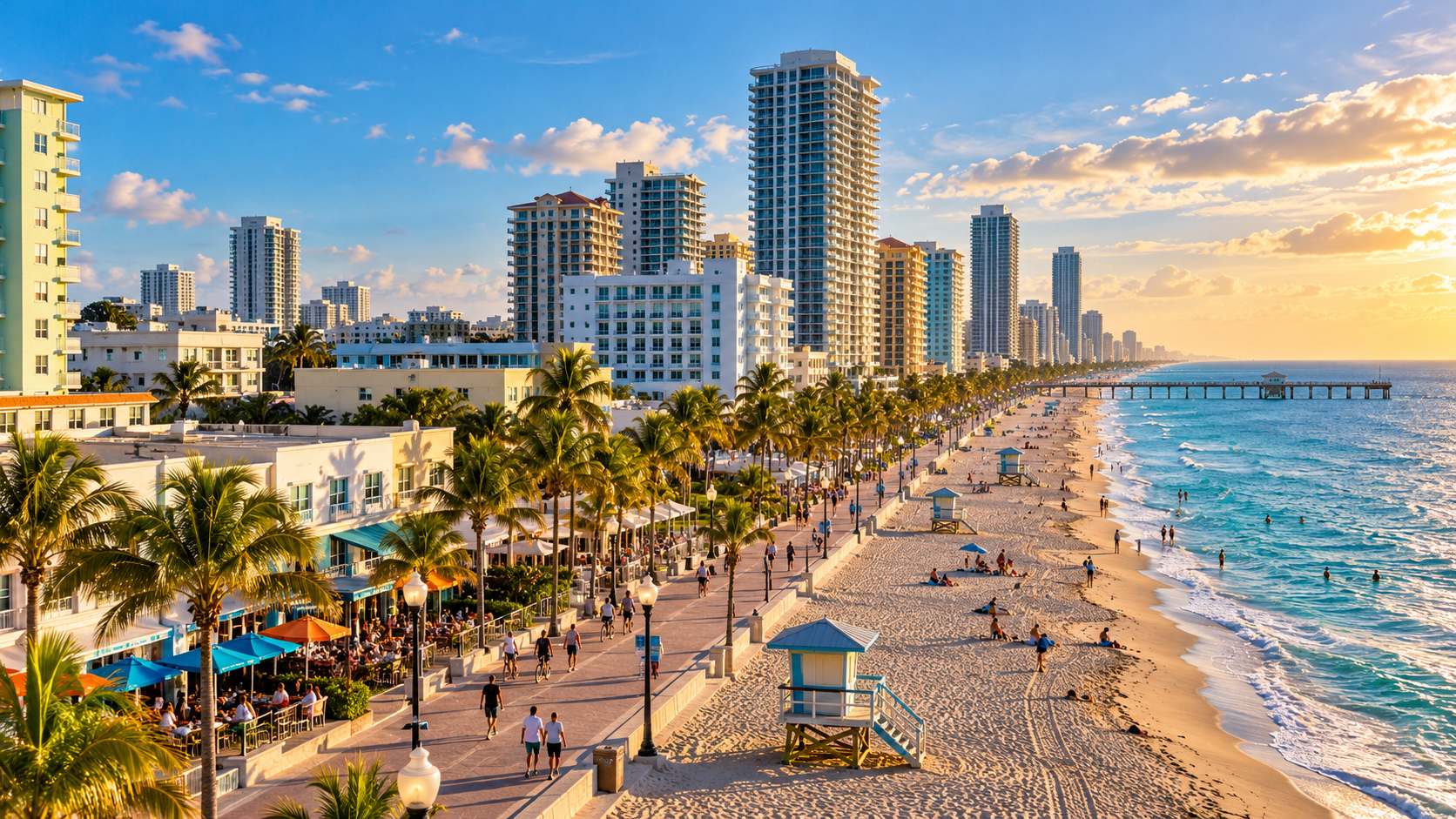
Hollywood Beach Commission Backs New Development Overlay in October Vote
The city is moving toward an optional zoning framework for selected beachfront properties. The reported vote does not approve any individual project.

October 28, 2026

6 minutes

October 28, 2026
Hollywood, Florida, has taken a significant step toward changing how certain sites on its barrier island can be redeveloped. On October 7, 2026, the City Commission voted 5–2 to approve the Hollywood Beach Overlay District, according to an October 8 report by Axios. The measure would create a route for eligible property owners to seek additional development opportunities in exchange for meeting location-specific design and public-benefit requirements.
The city's proposed ordinance and regulating plan provide the detail behind that news. They establish six beach precincts rather than one uniform rule for the entire waterfront. As of October 28, however, the city’s online legislative record still lists the second-reading item as Agenda Ready and its meeting minutes as Draft. The final enrolled text and effective date therefore require confirmation before this article is published as a definitive statement of current law.
What the Commission considered
The overlay proposal had passed a first reading on September 16. The October 7 meeting was scheduled for the next reading of Ordinance PO-2026-026a, which would establish Section 4.26 of Hollywood's zoning regulations, adopt a regulating map and urban design guidelines, and create a Hollywood Beach Public Benefit and Resilience Trust Fund. The ordinance also provides for a five-year sunset of the overlay framework.
Axios reported that the second-reading vote passed 5–2. The city’s official meeting portal confirms the date and legislative item but has not yet published a finalized action record. Those are different levels of confirmation, and the distinction matters for legal and real estate reporting.
Not a blanket increase in building height
The central point is geographic: the overlay does not simply raise height limits everywhere along Hollywood Beach. The proposed map divides the beach area into six precincts, with different eligibility, development standards and design conditions. City planning materials emphasize retaining a lower-scale setting near the Broadwalk while directing greater potential intensity toward parts of A1A.
The system is also voluntary. An owner who does not seek an optional overlay bonus remains governed by the property's underlying zoning and other applicable requirements. A property owner who does seek additional capacity must satisfy the rules for that particular site. The approval of a zoning framework is not the approval of a tower, a demolition permit or a construction start.
That distinction is useful when comparing real estate in Hollywood. The city's overall property market includes inland neighborhoods as well as beachfront sites. The overlay is relevant only where its official map and eligibility rules apply.
Which development bonuses are on the table?
The ordinance describes several separate mechanisms. A height bonus could allow additional building height at eligible mapped locations, subject to specific reviews and public-benefit conditions. Tourism Incentive Density Entitlements (TIDE) concern hotel-room capacity at sites where the relevant lodging use is permitted. Flexibility Units and Transfer of Development Rights (TDR) are distinct ways of allocating residential density, each subject to its own limits.
The proposed code also addresses certain parking and building-design flexibilities, predominantly for specified nonresidential uses. The city's published explanation stresses that a bonus for residential density does not automatically reduce residential parking requirements. Nor does receiving one type of bonus confer the others.
A special redevelopment pathway is outlined for parts of Precinct 4, including the Hollywood Beach Resort site. Requests for height above the baseline outlined for that pathway would require additional review, including an independent feasibility assessment and a discretionary City Commission determination. Such a review is not a promise of approval.
Why Hollywood is pursuing the change
Hollywood's Planning and Urban Design Division presents the overlay as a local way to guide redevelopment while preserving existing property rights. The city points to limits on local discretion under Florida's Live Local Act and other state legislation, and argues that optional incentives could secure public space, parking improvements, resilient infrastructure and stronger design standards.
The initiative is contested. Axios reported that residents speaking at the October meeting raised concerns about taller buildings, flooding, traffic and the character of the barrier island. Supporters argued that a locally negotiated framework could give Hollywood more control over the design and public benefits of future projects. Those competing positions should not be confused with measurable effects that have already occurred.
What it means for property owners and buyers
For someone assessing a site, the first question is not how tall a future building might be, but whether the parcel is inside an eligible overlay area and which underlying zoning rules still apply. The next questions concern the specific bonus requested, public-benefit obligations, site-plan review, environmental and resilience requirements, and any additional permits.
For existing condominium owners and prospective buyers, the new framework may be relevant to future construction proposals nearby. But it does not establish that a particular neighboring lot will be redeveloped, that views will change, or that property prices will rise or fall. Those conclusions require separate project-level evidence.
For a citywide comparison beyond the beachfront overlay, readers can explore multi-family properties in Hollywood and townhouses in Hollywood. These catalogs cover properties throughout Hollywood; they do not identify sites that qualify for the proposed overlay.
Commercial property searches can be considered separately through mixed-use properties in Hollywood and office properties in Hollywood. A listing in either category does not establish the parcel’s overlay eligibility, permitted building height or redevelopment rights.
What happens next
The reported October 7 vote is a meaningful legislative milestone. The next editorial check is the finalized ordinance, recorded vote and effective date, followed by the official regulating map and any property-specific applications filed under the framework. Only then can future proposals be evaluated against the adopted requirements instead of preliminary drafts.
Explore Miami housing and real estate
- Hollywood real estate — Browse citywide real estate; the overlay applies only to selected beachfront sites
- Hollywood condos — Compare condominium listings throughout Hollywood, not just the affected beach parcels
- Hollywood commercial properties — Review the wider commercial property market, not overlay entitlements
- Homes in Hollywood — Explore homes in the city beyond Hollywood Beach
Interested in Florida Real Estate?
- Florida real estate — Browse property listings across the state
- Florida condos for sale — Explore condominium inventory
- Florida homes for sale — Explore single-family homes