Schools in Miami: A Parent’s Guide Before Buying a Home
Buying a home in Miami with school choice in mind? We explain how the school system works, the advantages and limitations of different education options, and what to check before buying a property.

30.09.2026

23 minutes

October 1, 2026
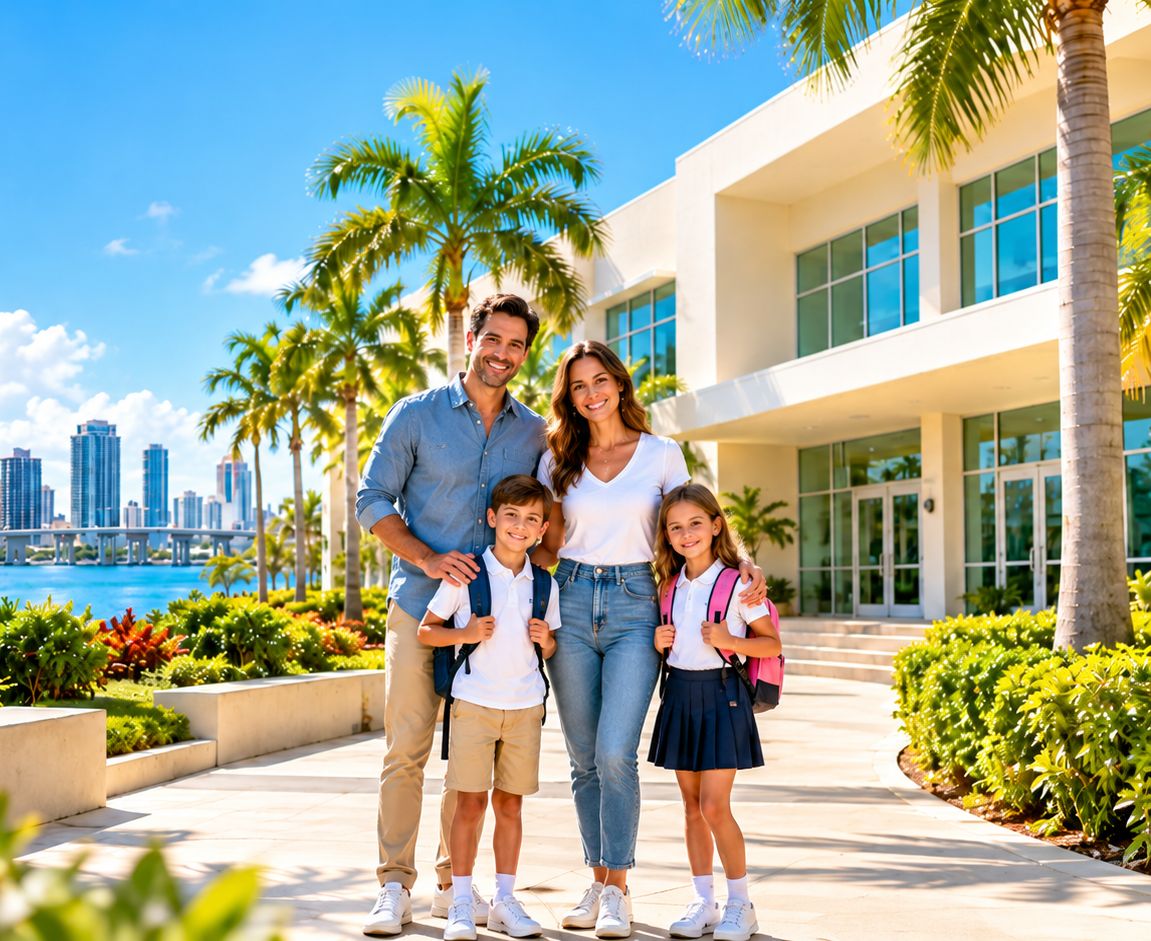
Choosing a school when moving to Miami becomes easier once you understand the three main options: a traditional public school, a charter school or a private school. Next, identify your child's grade level, check admission requirements and gather the necessary documents.
This guide covers Miami and nearby communities in Miami-Dade and Broward counties. Each has its own school district and registration procedures. The starting point is straightforward: your assigned public school provides a basic enrollment route, while other options require an application.
Public, charter and private schools in Florida
A school's type determines how it is managed, whether it charges tuition and how students enroll.
| School type | Tuition | Enrollment route |
|---|---|---|
| Traditional public school | Free | Usually through the school assigned to your home address. District transfers and specialized programs provide additional options. |
| Charter school Independently managed public school | Free | Submit a separate application. If applications exceed available seats, a lottery is held with any permitted admission preferences. |
| Private school | Paid; financial assistance may be available | Follow the school's admissions process. This may include interviews, testing and a review of previous school records. |
Charter schools are part of public education. They may differ in curriculum and organization, but must meet applicable state requirements. The Florida Department of Education explains the framework.
Elementary, middle and high school: a separate distinction
Elementary, middle and high school describe stages of education. All three school types can serve these stages. A campus may cover one stage or combine several.
| Level | Typical grades | Approximate ages |
|---|---|---|
| Elementary school | Kindergarten–grade 5 | 5–11 |
| Middle school | Grades 6–8 | 11–14 |
| High school | Grades 9–12 | 14–18 |
Ages are approximate. K–8 schools combine kindergarten with grades 1–8; K–12 schools continue through graduation. Following a move, placement takes account of age, records and previous schooling.
Preschool, VPK and kindergarten
Preschool is early childhood education, offered by separate centers and some schools. Florida's free Voluntary Prekindergarten program, or VPK, serves state residents who turn four by September 1. The program itself is free; extended care and additional services may cost extra.
Kindergarten is the school year before first grade. For regular entry into public kindergarten, children must turn five by September 1. First-grade entry requires turning six by that date and completing kindergarten. State rules provide certain exceptions for transfers from other states. See the official age and enrollment requirements.
How to enroll in a public school
Your assigned public school is the main starting point after a move. Regular zoned enrollment does not require winning a lottery. Begin by checking your address and speaking with the school registrar.
- Find your assigned school. Use the Miami-Dade school directory or Broward Find My School. Confirm the assignment with the school or district.
- Review results and programs. Look up the school on the state's Know Your Schools portal. Check the relevant grade level and English-language support.
- Contact the school office. Provide your child's age, previous grade and expected moving date. Request the current document checklist and enrollment forms.
- Submit documents and finish registration. Confirm the starting date, schedule, meals, transportation and parent-portal access.
Renting a home is sufficient if you can establish actual residence. Buying a property does not provide a place at any school you choose. The district confirms your assignment and available programs.
Documents commonly requested
- Proof of the child's name and date of birth, such as a birth certificate or passport.
- Parent identification and guardianship documents where applicable.
- Proof of residence: a lease or ownership documents, plus additional evidence required by the district.
- School-entry health documentation.
- Report cards or transcripts from the previous school. Completed courses and credits are especially important for high school.
- School forms covering family details, home language, emergency contacts and authorized pickup arrangements.
Ask the registrar for the exact checklist and translation requirements. The Miami-Dade registration guide and Broward enrollment requirements provide a starting point. If documents are missing, explain the circumstances promptly: special procedures apply in certain situations.
Immunization records, exemptions and a physical examination
School immunizations are documented on Form DH 680. Bring vaccination records from abroad so an authorized Florida provider can review them and prepare the required record.
A qualifying religious exemption uses Form DH 681, issued by a county health department. A physician documents a qualifying medical exemption on DH 680. A personal letter declining vaccination does not replace these forms. See the Florida Department of Health exemption guidance.
Initial entry into a Florida school generally requires a physical completed within the preceding 12 months. A pediatrician or an urgent care clinic offering school-entry physicals can help. Confirm that the clinic provides the required documentation. DH 3040 is the recommended form; an equivalent qualifying record from a provider licensed in the United States is also acceptable. See the official school-entry health requirements.
How charter school admission works
Charter schools vary in academic results, programs and approach. The label alone does not guarantee quality. Compare the actual campus, its offerings and its performance over several years.
Start with an application for the appropriate grade. When applications exceed seats, the school holds a lottery. Permitted preferences may apply, such as for siblings of current students. Other applicants enter a waiting list. The Broward charter school FAQ explains the process.
Seats can become available after the main admissions round. A grade may have openings, or an accepted family may decline. Contacting the office is worthwhile, but the school must still follow its admissions and waiting-list procedures.
Miami-Dade and Broward: where to apply
There is no single application portal covering every charter school in both counties. Start with Admissions or Enrollment on the official website of the specific campus. It should identify the application service, deadlines and available grades.
| Option | Where to start |
|---|---|
| Miami-Dade charter schools | Apply through the individual school. For example, Ben Gamla Kendall publishes its own enrollment page. |
| Broward charter schools | Use the campus website: Ben Gamla Hollywood links to its application; Hollywood Academy of Arts & Science uses SchoolMint. |
| District magnet programs and transfers | These follow separate routes: Miami-Dade Magnet Programs and Broward School Choice through the Focus Parent Portal. They do not replace charter applications. |
Your county can affect availability and preferences, but crossing a county boundary is not an automatic bar to admission. Check the campus rules and Controlled Open Enrollment requirements. Confirm transportation separately: the family may need to arrange the journey.
A practical approach is to apply to several suitable schools and track each offer's acceptance deadline. Keep your assigned public-school option available until another enrollment is confirmed.
Private schools: examples and costs
Private schools set their own admissions procedures. Being able to pay does not guarantee acceptance: testing, selection and limited space may apply. Begin with a visit and a conversation with the admissions office.
These examples cover Miami-Dade and neighboring Broward. They are comparison points, not a ranking. Amounts are in US dollars for the billing period specified by the school.
| School | Published tuition | Official information |
|---|---|---|
| American Heritage Schools, Broward Campus Plantation | 2027/28, annually: kindergarten $40,300; grades 1–5 $43,400; grades 6–8 $46,400; grades 9–12 $49,800. | Tuition, additional fees and aid |
| Sunshine State Academy Hollywood | 2026/27: kindergarten–grade 8, $2,250 per four weeks, plus additional fees. | Rates and billing periods |
| Gulliver Preparatory School Miami-Dade | 2026/27, annually: PK–SK $36,400; grades 1–4 $40,200; grades 5–12 $56,100. | Tuition and included services |
| Ransom Everglades Miami | 2026/27: $57,300 annually, including lunch. School financial aid is available; vouchers are not accepted. | Tuition and financial aid |
American Heritage's published figures above are for 2027/28; the other rows show 2026/27. Request a separate quote for another year. A four-week billing period is not a calendar month: calculate Sunshine's annual total using its payment schedule.
Questions to ask before applying
- Is there a seat in the right grade, and what admissions steps are required?
- Does tuition include meals, textbooks, devices or transportation?
- What are the charges for registration, uniforms, aftercare, activities and trips?
- How does the school support children who are still learning English?
- Is school aid or scholarship funding available? What are the deposit refund terms?
Religious schools and Ben Gamla: understanding the difference
South Florida has private schools combining general academics with religious education. Consider daily routines, traditions, admission requirements and family expectations alongside academic results.
- Hebrew Academy in Miami Beach is a Modern Orthodox Jewish school combining general studies with Torah, Hebrew and Jewish learning. See its official admissions page. Published 2026/27 tuition ranges from $20,890 for kindergarten to $32,805 for high school, before additional fees: school tuition schedule.
- Posnack School combines general academics with Jewish education and Hebrew. Explore its approach and admissions on the official school website.
- Belen Jesuit Preparatory School in Miami is a Catholic Jesuit school for boys in grades 6–12. Its official admissions page explains the approach and application process.
Ben Gamla belongs to a different category. It is a public charter option offering Hebrew language instruction. See Ben Gamla Hollywood's official website. Florida requires charter schools to be nonsectarian in their programs and operations, as explained in the state guidance.
How to assess a school: ratings, programs and daily life
Start with Know Your Schools, Florida's official portal. It provides public and charter school reports and performance information. State school grades use letters A–F, a different system from commercial websites' 1–10 scores.
The region has hundreds of schools. A precise total depends on whether you count one county or both and include public, charter and private schools. For an actual decision, a current list serving your child's grade is more useful than an overall count or an “average Miami rating.”
- Look at trends. Check the reporting year and several years of results.
- Explore support. Ask about English learning, academic difficulties and additional educational needs.
- Examine the curriculum. A high overall grade does not establish that a particular course or teaching pace is right for your child.
- Visit the campus. Observe staff interaction, discuss workload and schedules, and test the daily journey.
Gifted education, advanced courses and college preparation
Gifted programs serve students who meet eligibility criteria following evaluation. Traditional public schools offer them too. Ask the individual school about availability and referrals.
For high school, compare Honors, AP, IB, Cambridge AICE and dual enrollment, which allows eligible students to take college courses while still in school. Availability and entry requirements vary. Research projects, academic competitions, debate, arts, sports and counselor support can also matter.
A strong school can expand opportunities and support college preparation. A school's name or promise to “develop leaders” is less useful than its actual course schedule and participation requirements. College admission also depends on the student's own achievements.
How schools relate to neighborhoods and housing costs
For a family choosing a traditional public school, schooling and housing are directly connected. Homes assigned to sought-after schools may attract additional interest. Prices also depend on the property, building condition, ongoing costs and market conditions.
Check the school before signing a lease or purchase contract. Nearby addresses in the same city can have different assignments, and boundaries can change. Obtain confirmation from the district rather than relying only on a property listing.
For younger children, review the whole sequence: elementary, middle and high school. If you plan on a charter school, assess admission timing and uncertainty first. Purchasing nearby does not replace the application process.
At resale, a school assignment may be an additional consideration for buyers with children. It does not determine who can buy or guarantee a price premium. Compare the whole family budget: housing, tuition, transportation and travel time.
Safety, English support and the first weeks
Florida public and charter schools must meet school-safety requirements, including safe-school officers and emergency preparedness. The Office of Safe Schools provides general information. Published policies should be considered alongside the everyday practices of the actual campus.
During a visit, ask about visitor screening, authorized pickup, incident notifications and responses to bullying. For a private school, ask specifically about security arrangements and emergency plans.
Limited English is a reason to discuss support early, rather than delay contacting a public school. A home-language questionnaire may lead to an English assessment. Ask about ESOL services and communication with teachers; the Florida Department of Education provides information on language support.
A simple plan for your family
- Identify your child's grade level, needs and your budget.
- Check the public school assigned to your proposed address.
- Shortlist suitable charter or private options if relevant.
- Confirm deadlines, available seats and required documents.
- Visit schools and test the journey on a typical school morning.
- Obtain enrollment confirmation and arrange the first day.
If your first choice is unavailable, you can begin with your assigned school, stay on a waiting list or explore another program. You do not need to solve everything at once: secure education now and work toward the best long-term fit for your child.
Frequently asked questions about Miami schools
Can my child start school during the school year?
Yes. Contact your assigned public school as soon as you move. Charter and private transfers depend on vacancies and admission policies.
Do I need to own a home to use a public school?
No. A rental home qualifies when you establish actual residence. Ask the school which documents apply to your situation.
Can I choose a public school outside my assigned area?
You can apply through available school-choice or transfer programs. Admission depends on program rules and capacity; it is not automatic.
Do all charter schools require a lottery?
No. A lottery is required when applications exceed available seats. If places remain, the school may admit students through its enrollment process. Check whether a waiting list applies.
Can I apply to several charter schools?
Usually, subject to each school's rules. Track every application separately. Once you choose a place, promptly decline other offers you no longer need.
Does buying near a charter school guarantee admission?
No. Some schools have permitted geographic preferences, but proximity alone does not replace the admissions process.
Can I apply before moving?
Ask the school first. An initial application and final enrollment are separate stages. Proof of residence may be required by a specific deadline.
Which portal should I use for a charter application?
Follow Admissions or Enrollment on the campus's official website. Broward School Choice is not a universal charter application. Examples of school-specific routes appear above.
What if some documents are missing?
Tell the registrar what is missing. Contact the school promptly so it can explain acceptable evidence, deadlines and any procedures applicable to your circumstances.
Do school and vaccination records need translation?
Send a list of your documents to the school and healthcare provider in advance. They can specify translation requirements. School immunization documentation must follow Florida's accepted format.
Can a child enroll without strong English?
Public schools provide support for English learners. Ask private schools separately about language requirements at admission and the assistance they offer.
Are gifted programs limited to private and charter schools?
No. Traditional public schools offer them too. Students must meet eligibility criteria; a school having a program does not mean automatic placement in it.
Are public and charter schools completely free?
They do not charge tuition. Families may still have expenses for uniforms, supplies, aftercare, some trips and optional activities.
Will a school bus be available?
That depends on the address, district rules and program. Charter and private arrangements vary. Confirm eligibility, routes and charges before choosing.
Does attending preschool guarantee a kindergarten place?
Not always. Ask about progression rules. Some charter schools provide preferences for their own VPK students, but that is not a universal admission guarantee.
Is Ben Gamla a fee-paying religious school?
No. For example, Ben Gamla Hollywood is a tuition-free public charter school offering Hebrew instruction. Private religious schools are a separate category.
What if my child has additional educational needs?
Share existing evaluations and support plans, such as an IEP or 504 plan. Discuss services and evaluation procedures. Do not assume that every private school provides the same services as a public school.
Can my child transfer from private or charter to public school later?
Yes, through registration and the transfer of school records. For high school, discuss course recognition, credits and graduation requirements in advance.
Is financial assistance available for private school?
School-based aid and Florida scholarship programs may help. Participation, eligibility and amounts vary. Check with the school and the state's official scholarship resources.
What if the school turns out to be a poor fit?
Discuss difficulties with the teacher and administration first. If they remain unresolved, explore transfers or other charter and private options. Plan the move so education continues without a gap.
- — Public, Charter, and Private Schools: How Florida’s School Options Work
- — Elementary, Middle, and High School: Understanding the Grade Levels
- — How to Enroll Your Child in a Public School
- — How Charter School Admissions Work
- — Private Schools: Examples, Tuition, and Costs
- — Religious Schools and Ben Gamla: Understanding the Difference
- — How to Evaluate a School: Ratings, Programs, and Learning Environment
- — How School Assignment Relates to Neighborhoods and Housing Costs
- — School Safety, English-Language Support, and the First Weeks
- — Where to Start: A Simple Step-by-Step Plan
- — Frequently Asked Questions About Schools in Miami