Transaction Broker in Florida When the Buyer Is Found
Buyer and seller already agreed on a price? The contract, deposit, inspections and closing still lie ahead. See what to put in writing, which disclosures to gather, and how a transaction broker differs from no brokerage relationship.

12.11.2026

17 minutes

November 12, 2026

Buyer found: what happens next
If both parties have already agreed to a sale, professional help with a Florida real estate transaction can help organize the next steps. These include the contract, deposit, property disclosures, inspections, and closing. The scope of help depends on what has already been done and which tasks the parties are ready to handle themselves.

At BonaDomus, we do not see finding a buyer as the only reason to work with an agent. Once the price is agreed, documents and deadlines still affect each party's rights. We assist with these transactions as a transaction broker, providing limited representation, or under no brokerage relationship, without representation.
This article was written by Andrei Jumatii, BonaDomus. It is intended for buyers and sellers in Miami-Dade, Broward County, and other Florida counties. Before signing documents, check current laws and how they apply to your transaction with a Florida real estate attorney.
For sale by owner: what buyers and sellers need to agree on
An agreed price does not settle all the terms of a sale. The parties need a written purchase and sale agreement that sets out payment terms, deadlines for a home inspection, and grounds for canceling the transaction. A verbal agreement does not resolve these issues.
Before signing, discuss:
- Deposit. How much the buyer will pay, when it is due, and who will hold it.
- Inspection. How much time is allowed to inspect the property and what rights the findings give the buyer.
- Financing. Whether a loan is needed and what happens if the buyer does not receive approval by the deadline.
- Title company. Who chooses the company that checks ownership rights and helps handle the closing.
- Closing costs. Which payments each party will cover.
- Included items and property condition. Which appliances stay and what work the seller will complete before handing over the property.
- Closing and possession. When documents are signed, funds are transferred, and keys are handed over.
For example, the buyer assumes that furniture is included in the price, while the seller plans to take it away. Listing the items that will stay in the contract resolves this issue before moving day.
Common for sale by owner scenarios
You can sell homes in Florida without a real estate agent. This approach is often called FSBO, short for For Sale By Owner: the owner sells the property independently.
Professional help may be useful in several situations:
- The owner advertised the property and found a buyer independently.
- Friends or neighbors agreed to a sale.
- A tenant is buying the home they live in.
- The parties agreed on a price and want to prepare the documents.
- The contract has already been signed, and help is needed with the remaining steps.
Knowing each other does not replace written terms. Discuss the tax implications of a below-market sale between relatives separately with a tax adviser.
How to sell a house without a realtor: when to bring in a broker
Bringing in a broker is more useful before signing the contract, while there is still time to discuss terms and inspections. Help is also possible after signing, but the agreed deadlines are already running. Changing the contract generally requires the parties' consent.
| When the broker gets involved | How they can help by agreement | What to keep in mind |
|---|---|---|
| Before signing | Discuss terms, agree on deadlines, coordinate disclosure collection, and help complete an appropriate contract form. | An attorney reviews nonstandard legal terms. |
| After signing | Create a calendar of remaining deadlines, contact participants, and coordinate closing preparations. | Bringing in a broker does not extend deadlines or restore lost rights. |
If the contract is already in effect, give the broker a copy along with all addenda and notices. It is especially important to flag an approaching inspection or loan approval deadline right away. Professional assistance does not guarantee favorable terms or a successful closing: decisions remain with the parties.
Working with a transaction broker or with no brokerage relationship
A transaction broker provides limited representation to one or both parties. Under no brokerage relationship, the broker works without representation. BonaDomus offers both arrangements, but the scope of services and fees must be agreed separately.
Under Florida Statutes 475.278, a licensee must do the following under either arrangement:
- Deal honestly and fairly.
- Account for all funds entrusted to them.
- Disclose known facts that materially affect the value of residential property and are not readily observable to the buyer.
A transaction broker must also use skill, care, and diligence. They must present offers and counteroffers promptly unless a party has directed otherwise in writing. Limited confidentiality also applies, protecting certain information about a party unless that party waives it in writing.
As Florida Realtors explains, this is limited representation, without the full loyalty to one client that single agency involves. Saying that the broker "represents the transaction" is incorrect: the broker provides limited representation to people.
No brokerage relationship is established in writing. When the statutory notice requirement applies, the No Brokerage Relationship Notice must be provided before showing the property. There are exceptions to this requirement, so the procedure must be checked against the circumstances of the sale.
Single agency is a separate alternative with fiduciary duties to one party, including loyalty and confidentiality. Transitioning from single agency to transaction broker requires the client's prior written consent. Dual agency, in which a broker acts as a fiduciary representative for both parties, is prohibited in Florida.
Hypothetical example: price limits
Imagine a hypothetical situation: the seller is willing to accept less than the asking price, and the buyer is willing to pay more than their offer. Both have told the broker.
- With a transaction broker, these price limits are protected by limited confidentiality unless the relevant party waives that protection in writing.
- Under single agency, the agent keeps their client's information confidential. The law calls that client the principal.
- Under no brokerage relationship, there is no specific statutory duty of limited confidentiality. It would be wrong to promise automatic protection for this information or claim that the broker must disclose everything.
Separate confidentiality agreements and other applicable duties must be reviewed independently. They do not change the broker's status. No relationship type, by itself, determines the fee or removes other applicable requirements.
Hiring a real estate agent in Miami-Dade or elsewhere in Florida: what to put in writing
The services and fees need to be set out in a written agreement. Some parties need help before signing the contract, while others need coordination through closing. A notice describing the broker's status does not replace that agreement.
Statutory duties apply regardless of the list of additional services. The agreement should specify what work the broker will handle beyond those duties:
- Helping complete the contract and agree on terms within the broker's professional scope.
- Coordinating the collection of disclosures and association documents.
- Maintaining a calendar of contractual deadlines.
- Coordinating communication with the title company, lender, and inspector.
- Arranging the final walkthrough and closing preparations.
Also specify who pays for the services, when payment becomes due, and what happens if the transaction ends without closing. There is no universal "standard commission": compensation is negotiated for the specific assignment.
Before work begins, verify the licenses of the professional and brokerage through the DBPR search at myfloridalicense.com. Check the name, license number, and current license status.
How to gather disclosures before signing the contract
Disclosures provide information and notices that help the buyer evaluate the property and purchase terms. Which ones are needed depends on the property and the circumstances of the sale. Keep documents about the broker's status and fees separate: they do not disclose the home's condition.
- Gather known material facts. The seller reports problems and provides available reports or repair records.
- Identify applicable notices. Consider the property type, year built, and whether there is an association.
- Request missing documents. Some information comes from the owner, while other information comes from the association or developer.
- Document delivery to the buyer. Keep receipt dates and any acknowledgments required by the documents.
Collecting and reviewing documents does not guarantee that there are no problems. The list below helps organize the work, but it is not a universal package for every property.
Known hidden defects: a tile example
A known problem must be disclosed if it materially affects the home's value and is not readily observable to the buyer. This may include leaks or mold, as well as other conditions:
- Termite damage.
- Work completed without required permits.
- Sewer system problems.
- Known asbestos-containing materials, if the conditions requiring disclosure are met.
Hypothetical example: an agent knows that tile beneath a rug is damaged. If the damage materially affects the property's value and the buyer cannot see it, the agent must disclose it under transaction broker, single agency, and no brokerage relationship arrangements.
A seller's request to stay silent does not justify concealment. An AS IS provision, meaning a sale in the property's existing condition under the contract terms, also does not remove the duty to disclose known material hidden defects. However, not every cosmetic chip is material, and an agent is not required to guess at unknown defects or replace an inspector.

Notices based on property type and circumstances
| What is disclosed | When it applies | Who provides it | When it is delivered | Why it matters to the buyer | Why it matters to the seller |
|---|---|---|---|---|---|
| Information about HOA membership, dues, restrictions, and special assessments. | The property falls under HOA rules. This section does not apply to condominiums. | The owner in a resale, or the developer in an applicable developer sale. | Before entering into the contract. | Understand mandatory payments and homeowners' association restrictions. | Meet the disclosure requirement before entering into the contract. |
| Condominium documents, financial information, and applicable reports. | A condo sale under condominium rules. | The seller or developer under the applicable rules, with documents requested from the association. | According to the procedure and deadlines in the applicable law. Receipt of documents may start a contract cancellation period. | Assess the building's condition and financial obligations. | Deliver the required package and confirm the receipt date. |
| Information about flooding, insurance claims, and assistance received, in the form required by law. | A residential sale covered by flood disclosure rules. | The seller. | No later than entering into the contract. | Consider the flood history and need for flood insurance. | Provide the information required by law. |
| A warning about radon, a naturally occurring radioactive gas. | Properties and transactions covered by the radon statute. | The notice is included in the relevant transaction document. | Before or at the time of entering into the contract. | Know about the risk and the option to test. | Ensure the required notice is included. |
| Known information and reports about lead-based paint, a pamphlet, and a warning. | Most housing built before 1978, subject to exceptions under EPA rules. | The seller. If an agent is involved, the agent also has compliance duties. | Before the buyer becomes bound by the contract, with the required opportunity for an inspection. | Assess the risk and exercise the right to an inspection or risk assessment. | Meet federal requirements and retain supporting records. |
| Known information about asbestos where a disclosure duty applies. | There is no blanket federal duty for a seller to disclose asbestos, as explained in EPA guidance. State and local laws must be checked. | The seller and a licensee who knows the fact, within their respective duties. | Under applicable disclosure rules. | Decide whether a specialist inspection is needed. | Disclose a known material hidden fact when required. |
| The right to obtain a building energy-efficiency rating. | Properties covered by the energy-efficiency statute. | The buyer is notified as part of the sale process. | Before or at the time of entering into the contract. | Decide whether an additional assessment is needed. | Meet the notice requirement. |
For a condo in Miami, separately check whether a milestone inspection, a legally required building inspection, is available. Also check for a SIRS, or Structural Integrity Reserve Study, covering required reserves for structural elements and other specified components. The required document package and contract cancellation period must be determined under the current law for the specific type of sale.
Standard homeowners insurance generally does not cover flood damage. A radon notice does not, by itself, establish that gas levels are elevated, and it does not replace testing. An energy-efficiency notice explains the option to obtain a rating, not a requirement to do so.
Lead and asbestos rules differ. The lead inspection period provided under EPA rules may be changed by agreement or waived through the required procedure. It is incorrect to demand a universal federal asbestos form by analogy with lead requirements.
Also check whether notices apply concerning:
- Sewer connections.
- Property taxes.
- The property's coastal location.
- CDD assessments, charged by a Community Development District.
Broker status and the services agreement
The brokerage relationship notice explains whether the broker represents a party and what duties come with that status. The services agreement defines the tasks and fees. Neither document replaces information about the property's condition.
Working with a title company in Florida: steps from deposit to closing
After signing the contract, the parties must meet deposit, inspection, and financing deadlines. Some tasks run in parallel, so we recommend putting them on one calendar. Use the deadlines in the signed contract, not a sample schedule from another transaction.
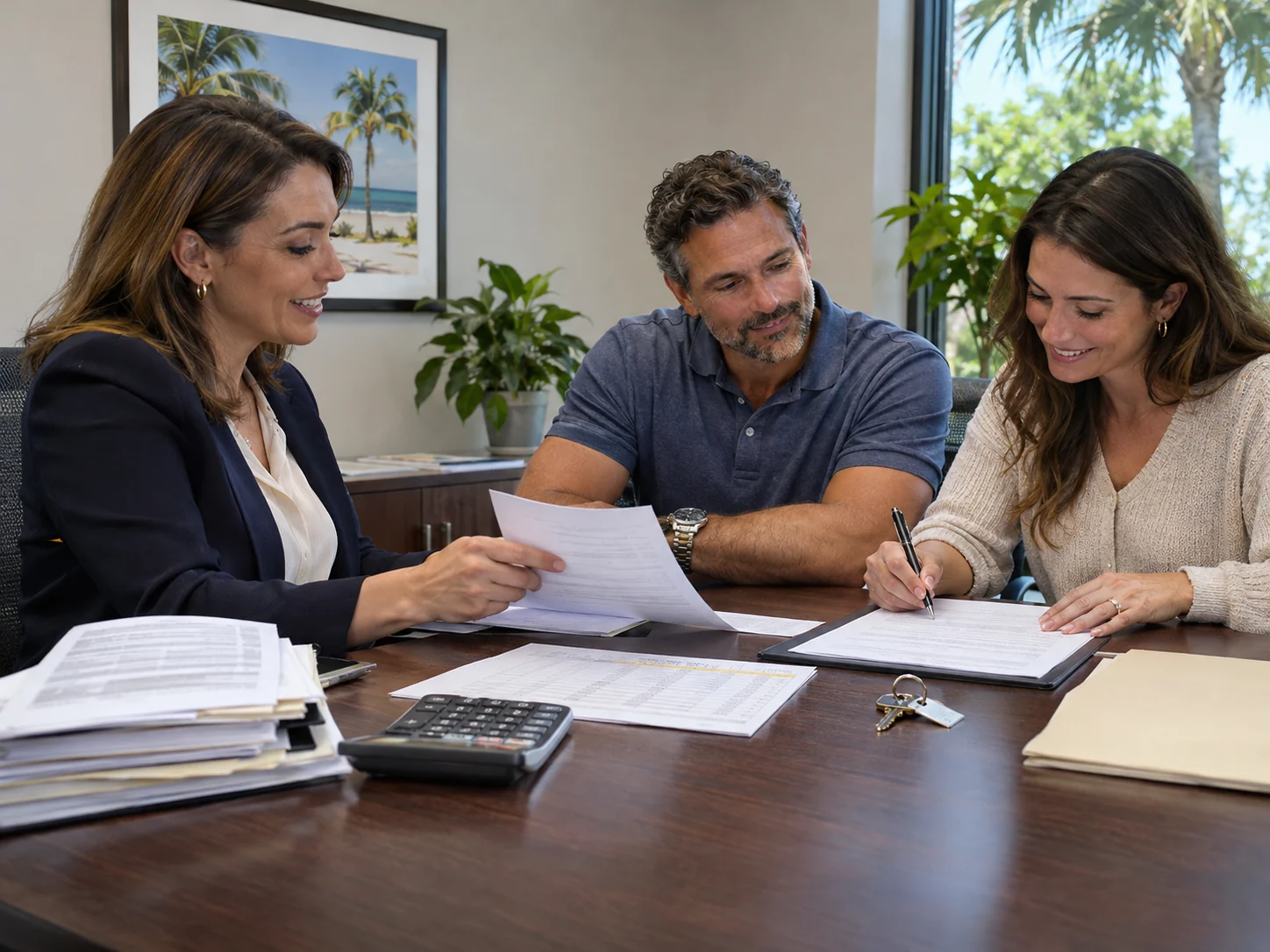
- Pay the escrow deposit. It is held by the escrow agent named in the contract, such as a title company or attorney, not by BonaDomus. Before wiring funds, confirm the payment instructions by calling a previously verified number. Do not rely solely on contact details in an email containing new payment instructions.
- Complete the inspection. The inspector checks the property's condition within the agreed scope. The buyer reviews the report and makes a decision within the contract's rights and deadlines. A repair request or cancellation must follow the required procedure.
- Finalize financing. If a loan is needed, the buyer provides documents to the lender. The lender arranges an appraisal and decides whether to approve the loan. Preapproval does not replace meeting all funding conditions.
- Check title and association information. The title company performs a title search to check ownership rights and identify recorded liens and other encumbrances. Information about dues and outstanding balances is requested from the HOA or condo association. Any issues found are addressed before closing in accordance with the contract.
- Prepare for closing. The parties review the final settlement figures and meet the remaining conditions. They then sign documents, transfer funds, and hand over possession at the agreed time.
A title search and title insurance serve different purposes. A search helps identify problems with ownership rights. An insurance policy covers certain risks under its terms and exclusions, but it does not insure the home's physical condition.
Closing costs and remote closing
Request a preliminary estimate of closing costs before signing the contract. It should separate each party's payments and clarify what each charge covers:
- Title company and closing services.
- Title insurance and recording fees.
- Applicable taxes and documentary stamp taxes.
- Lender costs if a loan is used.
- Florida HOA fees and prorations of ongoing expenses between the parties.
The contract and applicable rules determine who pays each amount. For properties in Miami-Dade and Broward, the estimate should be based on the property's address, without automatically applying terms from another county. Before signing the final documents, compare the figures with the agreed terms.
A remote closing is possible if the participants agree on the procedure. Check identity verification, notarization, and original-document requirements with the title company and lender in advance. If the seller is a foreign person for tax purposes or the buyer plans to take title through an LLC, involve an attorney and tax adviser before closing.
When to contact a real estate attorney in Florida and other specialists
Several professionals contribute to a transaction, each with different tasks. The broker coordinates the agreed part of the process but does not replace the other participants. Clear responsibilities help direct each question to someone qualified to address it.
| Participant | Main task | What to clarify |
|---|---|---|
| Broker | Performs the duties required by their status and the agreed services. | Which documents, deadlines, and communications they coordinate. |
| Seller | Discloses required information and meets the terms of the sale. | Which problems are known and what documents or work are still needed. |
| Buyer | Arranges inspections and financing, and makes timely decisions. | Which deadlines limit inspections or cancellation rights. |
| Title/escrow provider | Within the agreed scope, checks title, holds the deposit, and handles settlement funds. | Who actually holds the money and which encumbrances must be resolved. |
| Lender | Reviews the loan application and lending conditions. | Which documents and conditions remain before funding. |
| Inspector | Checks the property's physical condition within the agreed scope. | What the inspection covers and whether specialists are needed. |
| Real estate attorney | Provides legal advice and helps resolve legal issues. | Whether contract changes, a dispute review, or advice on nonstandard terms are needed. |
A broker does not provide legal or tax advice. Nor does a broker guarantee that every defect will be found. Questions outside the scope of brokerage work require the appropriate specialist.
What information helps define the scope of assistance
To discuss how we can help, we need to understand the property, the transaction stage, and the commitments already made. A signed contract and approaching deadlines matter more than a general description of the agreement. If the contract has not yet been signed, there is more room to discuss its terms.

Prepare:
- The address, property type, and year built.
- Information about HOA or condominium membership.
- The contract with all addenda, or a draft of the agreed terms.
- Details of the deposit, its recipient, and its due date.
- A calendar of known deadlines and any notices already sent.
- Information about known property problems and available reports.
- The payment method: cash or financing.
Contact BonaDomus with details of the property, contract, and transaction stage. We will discuss a suitable working arrangement, scope of services, and fees.
A short glossary for reading transaction documents
Florida real estate documents use terms that refer to different parts of a transaction. These brief definitions help distinguish brokerage relationships from property disclosures and the handling of funds.
- Brokerage relationship - the type of relationship between a broker and a party to the transaction.
- Disclosure - information provided or a notice given. Its content depends on the specific document.
- Escrow - funds held by an agreed holder until the conditions for releasing them are met.
- Closing - completion of the transaction through document signing and settlement of funds.
- Material defect - a significant defect that affects the property's value.
- Limited confidentiality - protection required of a transaction broker for certain information about a party, including their price limit.
Start with documents and clear responsibilities
Finding a buyer lets you move forward with the sale, but it does not remove contractual deadlines or required disclosures. A practical first step is to gather the documents already signed and identify what remains to be done. You can then choose a brokerage relationship and put the specific scope of assistance in writing.
The parties need a clear process: who prepares each document, who makes each decision, and when action is due. Agree on that process before transferring a deposit or taking on new commitments.
I already have a buyer for my house in Florida. Do I still need a realtor?
Florida law does not require you to hire a realtor, and a for sale by owner (FSBO) sale is possible. After the price is agreed, there is still the contract, the deposit, disclosures, inspections, and closing, and their deadlines affect both parties' rights. A broker can take on part of this work under a written agreement. The parties still make the decisions.
Can a broker help if the purchase contract is already signed?
Yes. A broker can build a calendar of the remaining deadlines, contact the other participants, and coordinate preparation for closing. Bringing in a broker does not extend deadlines or restore lost rights, and the contract can usually be changed only if both parties agree. Give the broker the contract with all addenda right away and mention the next inspection or loan approval deadline.
What is the difference between a transaction broker and no brokerage relationship in Florida?
A transaction broker provides limited representation to one or both parties. They must use skill and care and keep limited confidentiality, for example by not revealing a party's price limit unless that party waives it in writing. Under no brokerage relationship, the broker represents no one, and this legal protection of information does not apply. In both formats, the broker must deal honestly, account for all funds entrusted to them, and disclose known material facts that the buyer cannot easily see.
Does selling a house AS IS mean the seller does not have to disclose known defects?
Yes. An AS IS clause does not cancel the duty to disclose known hidden problems that materially affect the home's value, such as leaks, termite damage, or work done without permits. A seller's request to stay quiet does not justify hiding them either. Still, not every cosmetic chip counts as a material defect, and an agent does not have to guess unknown problems or replace an inspector.
Who holds the buyer's escrow deposit in a Florida home sale?
The deposit is held by the escrow agent named in the contract, such as a title company or an attorney. BonaDomus does not hold deposits. Before sending money, confirm the wiring details by calling a phone number you have already verified. Do not rely only on contacts from an email with new payment instructions.
How much does transaction assistance cost, and is there a standard commission?
There is no universal standard commission: the fee is agreed for the specific scope of work. Put the services, who pays, when payment is due, and what happens if the deal falls through in a written agreement. A broker status notice does not replace this agreement. Before you start, check the agent's and the brokerage's licenses with the DBPR search on myfloridalicense.com.
What should I prepare before asking BonaDomus for help with a private sale?
Have the address, property type, and year built ready, plus any HOA or condominium details. You will also need the contract with all addenda or a draft of the agreed terms, the deposit details, and known deadlines. Add any known property problems and how the buyer is paying: cash or a loan. This makes it easier to see the deal's stage and the help you need.
- — Next Steps After Agreement
- — Terms to Agree On
- — When to Involve a Broker
- — Understanding Your Brokerage Relationship
- — Services and Fees in Writing
- — Property Disclosures and Documents
- — From Deposit to Closing
- — Who Handles Each Question
- — Preparing for Your First Consultation
- — Essential Real Estate Terms
- — Documents and Responsibilities First