Miami Real Estate as an Investment: How to Choose the Right Property, Area, and Strategy
Investing in Miami real estate is exciting for a reason: this market combines global demand, lifestyle appeal, tax advantages, luxury inventory, and long-term resale potential in one place. But the real question is not whether Miami is attractive — the facts already show why investors keep looking here. The question is how to invest wisely. In this guide, we look beyond the headlines and break down the numbers, property types, neighborhoods, rental rules, costs, risks, and due diligence details that help you choose a smart Miami investment strategy with confidence today.

25.06.2026

48 minutes

June 25, 2026
⚠️ Important!
Real estate in Miami can be attractive, but returns are not guaranteed. The right strategy depends on the property type, building rules, HOA requirements, rental restrictions, taxes, insurance, and resale liquidity. A serious investor should evaluate the property with a local real estate team, title company, CPA, insurance advisor, and, when needed, an attorney.
Is Miami Real Estate a Good Investment in 2026?
For the right buyer and the right property, Miami real estate can still be a strong investment in 2026. The key is to understand that Miami is not a single market. Single-family homes, older condos, new construction, branded residences, luxury waterfront properties, and short-term-rental-friendly buildings all behave differently.
The March 2026 Miami-Dade market data shows this clearly. Total Miami-Dade home sales increased 6.6% year over year. Single-family home sales rose 10.61%, while existing condo sales increased 2.88%. The single-family median sale price reached $674,000, and the existing condo median price reached $445,000.
Inventory tells an even more important story. Miami-Dade single-family homes had 5.7 months of supply in March 2026, which MIAMI REALTORS described as a seller’s market. Existing condominiums had 13 months of supply, placing that segment in buyer’s market territory. A balanced market is usually between six and nine months of supply.
That means investors may find more negotiating room in condos, but they also need to be more selective. In today’s condo market, the building can matter more than the neighborhood. Reserves, insurance, special assessments, milestone inspections, rental rules, and owner-occupancy ratios can all influence investment performance.
Cash buyers remain a major force. In March 2026, cash sales represented 38.1% of Miami closed sales. MIAMI REALTORS also reported that 82% of Miami condo sales above $1 million were all-cash in 2025.
Miami Market in Numbers
| Indicator | March 2026 / Latest Reported Data | Why It Matters for Investors |
| Total Miami-Dade sales | Up 6.6% year over year | Shows continued transaction activity despite a selective market |
| Single-family sales | Up 10.61% year over year | Indicates stronger demand and tighter supply in houses |
| Existing condo sales | Up 2.88% year over year | Condo demand is improving, but investors must check building risk |
| Single-family median price | $674,000 | Higher entry point, stronger competition, more limited supply |
| Existing condo median price | $445,000 | More accessible than houses, but building due diligence is critical |
| Single-family inventory | 5.7 months of supply | Seller’s market conditions |
| Existing condo inventory | 13 months of supply | Buyer’s market conditions and more negotiating room |
| Miami cash sales | 38.1% of closed sales | Cash-heavy market can be less sensitive to mortgage-rate changes |
💬 Expert opinion from Bonadomus
Miami real estate can be a good investment in 2026, but not every Miami property is a good investment. The strongest opportunities usually come from matching a specific investment goal with the right property type, building, neighborhood, rental policy, insurance profile, and long-term exit strategy.
Why Florida and Miami Attract Investors from the U.S. and Abroad
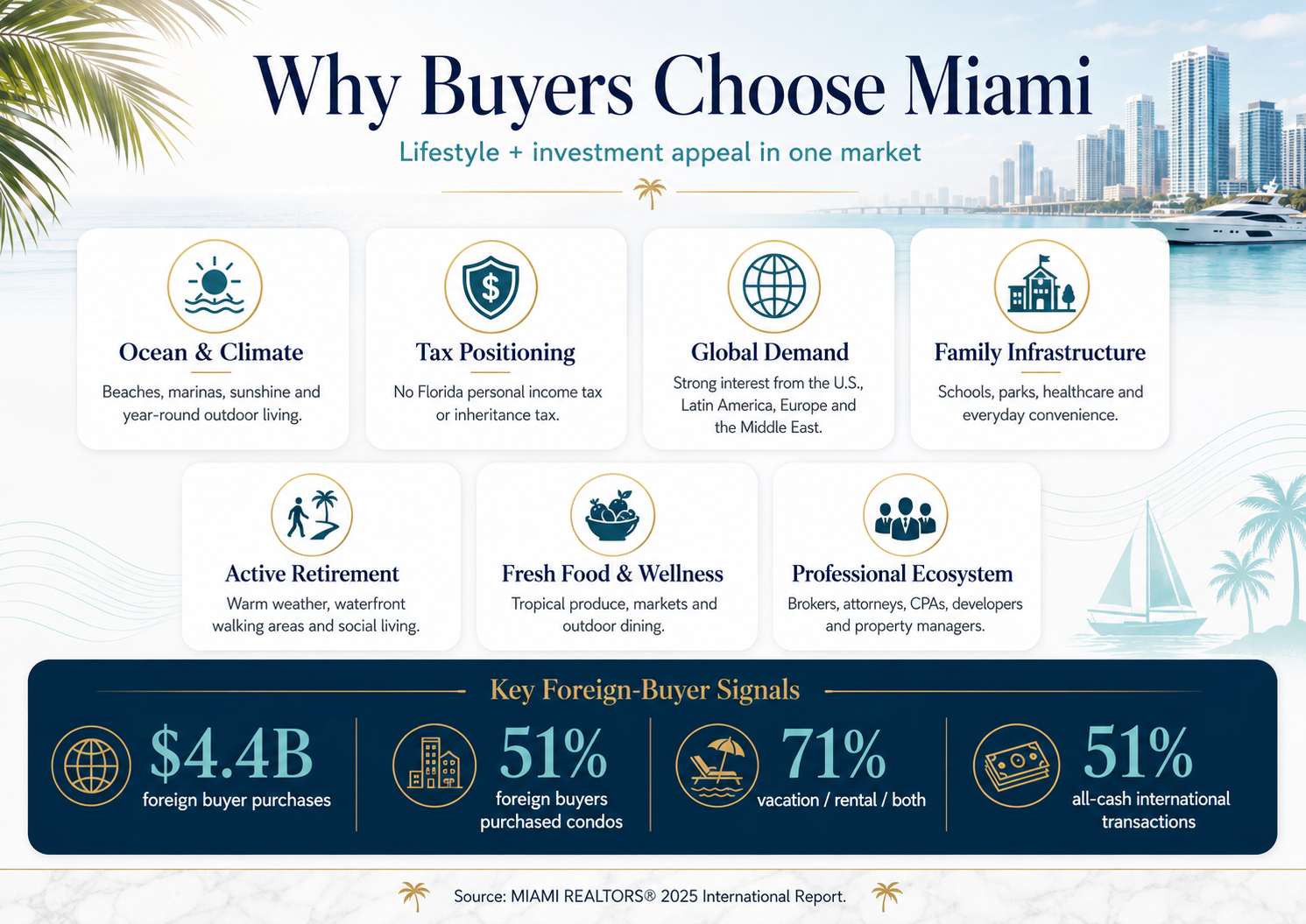
1. Florida remains attractive because it combines lifestyle, tax positioning, migration, business growth, and global recognition. But Miami should not be viewed only through taxes, purchase prices, or investment spreadsheets. People buy and rent property here because the city offers something more personal: a year-round coastal lifestyle that is difficult to replicate in most U.S. markets.
2. Miami’s lifestyle value starts with climate and the ocean. The city has warm weather for most of the year, around 250 sunny or partly sunny days annually, and direct access to beaches, marinas, waterfront parks, outdoor dining, sports, boating, and walking areas. For many buyers, this is not just a vacation benefit. It is a daily quality-of-life factor.
3. A property in Miami can appeal to several audiences at once: professionals relocating from other U.S. states, families looking for a warmer environment, international buyers, students, seasonal residents, retirees, digital entrepreneurs, and people who want a second home near the ocean. Some buyers plan to move immediately. Others buy first, use the property part-time, and rent it out while they are not in Miami.
4. For families, Miami offers international schools, residential neighborhoods, parks, beaches, sports facilities, cultural life, and access to major healthcare and business infrastructure. Miami-Dade County also offers year-round park and recreation programs for children, adults, and people with disabilities, while the City of Miami has more than 150 parks and over 1,400 acres of park space.
5. For older buyers and retirees, the appeal is different but just as important: warm weather, walkable waterfront areas, outdoor activity, social programs, healthcare access, and the ability to stay active year-round. Miami-Dade Parks also offers Active Older Adults programs with fitness, leisure, and social activities for adults 55 and older.
6. Miami also has a unique food and wellness advantage. Miami-Dade County says its tropical climate provides a year-round growing season and allows production of a wide range of crops. This supports the everyday lifestyle many buyers associate with South Florida: fresh fruits, vegetables, farmers markets, outdoor dining, and a healthier, more active rhythm of life.
7. The tax environment is another reason buyers consider Florida. The Florida Department of Revenue states that Florida does not impose personal income tax, inheritance tax, gift tax, or tax on intangible personal property. Property taxes still matter, and in Miami-Dade, real estate values are determined annually as of January 1, so buyers should calculate ownership costs carefully before purchasing.
8. For international buyers, Miami has another advantage - it feels familiar. The city functions as a bridge between the U.S., Latin America, Europe, and Middle East cultures. It has international schools, private banking, global brands, luxury hospitality, a major airport, and a deep network of brokers, developers, attorneys, lenders, accountants, and property managers who regularly work with foreign buyers.
💬 Expert opinion from Bonadomus
MIAMI REALTORS reported that foreign homebuyers purchased $4.4 billion of South Florida residential properties in 2025, up from $3.1 billion in 2024. About 51% of South Florida international residential transactions were all-cash, 51% of foreign buyers purchased condominiums, and 71% intended to use the property mainly for vacation use, rental use, or both.
Miami vs Other Florida and U.S. Markets:
Miami is not always the easiest Florida market for a pure cash-flow investor. Tampa, Orlando, Jacksonville, and other Florida markets may offer lower entry prices and more straightforward yield calculations. But Miami has a different advantage: it brings together multiple sources of demand within a single market.
A well-selected property can appeal to long-term tenants, professionals, students, seasonal residents, vacation users, foreign buyers, second-home owners, and future resale buyers. That is why Miami should not be evaluated solely by purchase price or monthly rental income. The more important question is whether a property can support multiple investment strategies over time.
For example, one Miami condo may function as a long-term rental today, serve as a second home in a few years, and later become a resale asset. Another property may be suitable for seasonal use or participation in professionally managed rental programs, provided the building, local regulations, and HOA rules permit it.
This flexibility is one of the main reasons investors continue to choose Miami, even when entry prices are higher than in many other Florida markets.
💬 Expert opinion from Bonadomus
PwC and the Urban Land Institute ranked Miami third among 81 U.S. markets for overall real estate prospects in the 2026 Emerging Trends survey. At the same time, the report notes more caution around apartment acquisitions in Miami compared with some other Southeast markets.
| Market | Best Investment Logic | Rental Potential | Main Risk |
| Miami | Global demand, long-term rentals, seasonal use, student/professional demand, second home, luxury resale, capital preservation | Strong, but highly building- and rule-dependent | Higher entry price, HOA, insurance, rental restrictions |
| Tampa / St. Petersburg | More accessible entry, family rentals, domestic migration | Good long-term rental potential | Less global liquidity and weaker international brand than Miami |
| Orlando | Tourism, family rentals, theme-park-related demand, suburban growth | Strong tourism and family rental logic | More dependent on tourism cycles and suburban supply |
| West Palm Beach | Ultra-luxury, privacy, wealth preservation | Limited but premium rental demand | Very high entry point and limited inventory |
| Jacksonville | Lower entry price, more cash-flow-oriented strategies | Better for lower-cost long-term rentals | Weaker global buyer demand and lower premium resale liquidity |
Your Miami Real Estate Investment Strategy
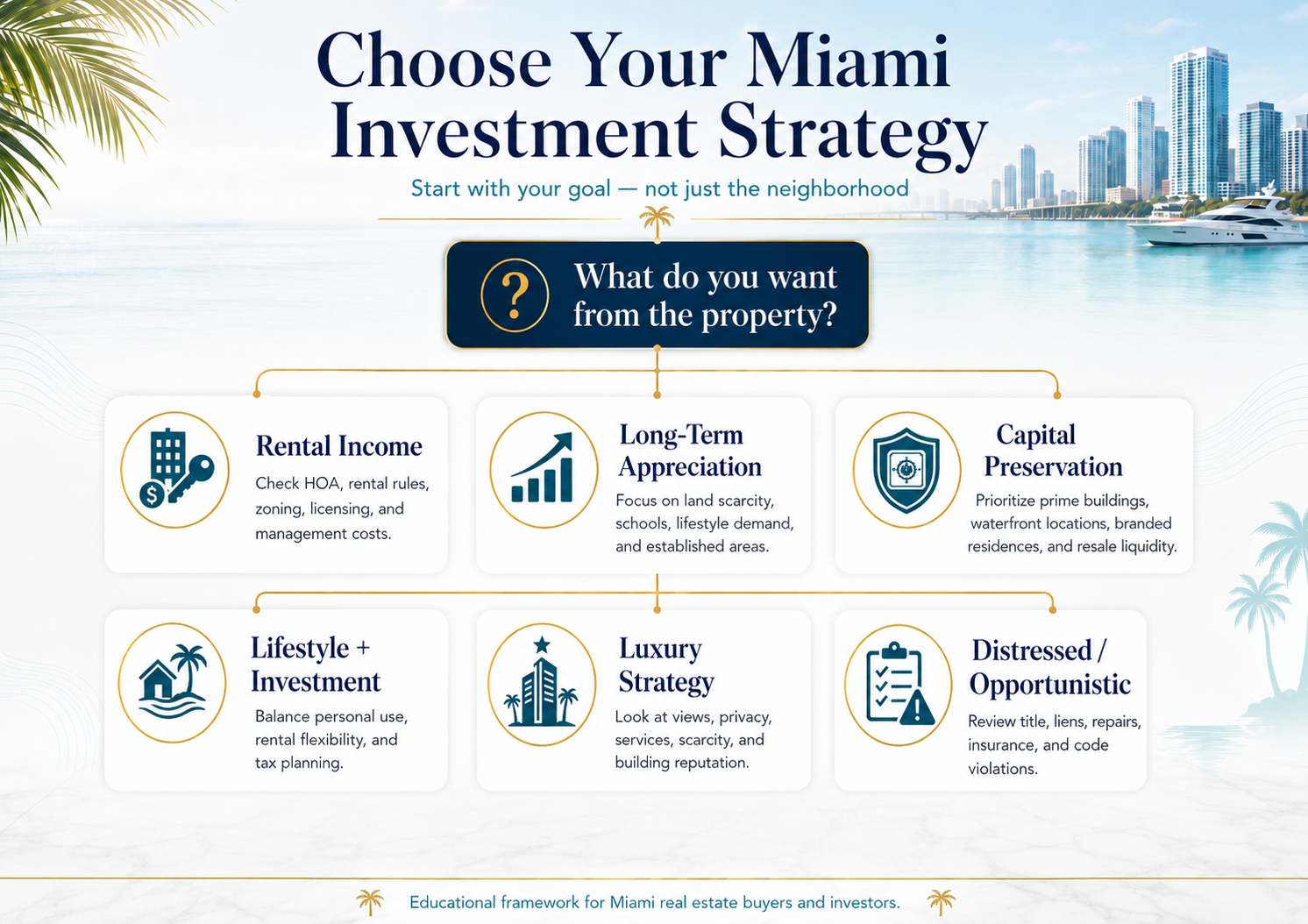
Before choosing a neighborhood or building, define the strategy. This is where many investors make their first mistake. They start with “Brickell or Miami Beach?” when the better first question is: “How does this property benefit me?”
3. Rental Income Strategy
This strategy focuses on income from long-term, seasonal, or legally permitted short-term rental use. It can work, but the building rules matter as much as the location. HOA documents, minimum lease terms, tenant approval rules, rental caps, city zoning, and licensing requirements must be checked before purchase.
A rental-income investor should not only ask, “How much can this property rent for?” The better question is: “Can this property be rented legally, consistently, and profitably after HOA fees, insurance, vacancy, management, taxes, repairs, and furnishings?”
4. Long-Term Appreciation Strategy
This strategy focuses on holding property in areas with strong demand, limited land, lifestyle value, good schools, waterfront access, or long-term neighborhood improvement.
Single-family homes in established areas and well-located condos in financially healthy buildings may fit this goal. Coconut Grove, Coral Gables, Miami Beach, Sunny Isles Beach, Brickell, Brickell Key, and Aventura often appear in appreciation-focused searches, but the specific property still matters more than the name of the area.
5. Capital Preservation Strategy
For high-net-worth buyers, Miami real estate investment is sometimes less about maximum yield and more about holding capital in a recognized U.S. market.
These buyers often prefer prime waterfront condos, branded residences, private homes, buildings with strong management, or properties with long-term resale appeal. The goal is not to chase the highest projected return. The goal is to buy an asset that remains desirable to future buyers.
6. Lifestyle + Investment Strategy
Many buyers want to use the property part of the year and rent it when they are away. This is common among foreign buyers and out-of-state buyers.
The strategy can be practical, but it requires careful planning around rental rules, taxes, furnishings, property management, insurance, and personal-use periods. A condo that is perfect as a vacation home may not always be ideal as a rental property.
7. Luxury Real Estate Strategy
Miami luxury real estate attracts buyers who value scarcity, privacy, views, branded services, concierge, wellness amenities, marinas, security, private elevators, and international liquidity.
In this segment, the best property is not always the cheapest per square foot. The better question is whether the building, view line, floor plan, service level, and location will remain desirable over time.
8. Opportunistic or Distressed Property Strategy
Foreclosed homes in Miami or distressed properties can look attractive on paper. But they require deeper due diligence: title, liens, unpaid HOA fees, repair budget, insurance availability, code violations, building condition, and resale demand.
Distress should not be treated as a shortcut. In March 2026, distressed sales represented only 0.4% of all closed residential sales in Miami, compared with 70% in 2009. In other words, foreclosures are not the main story of today’s Miami real estate market.
The Most Popular Types of Miami Real Estate for Investment
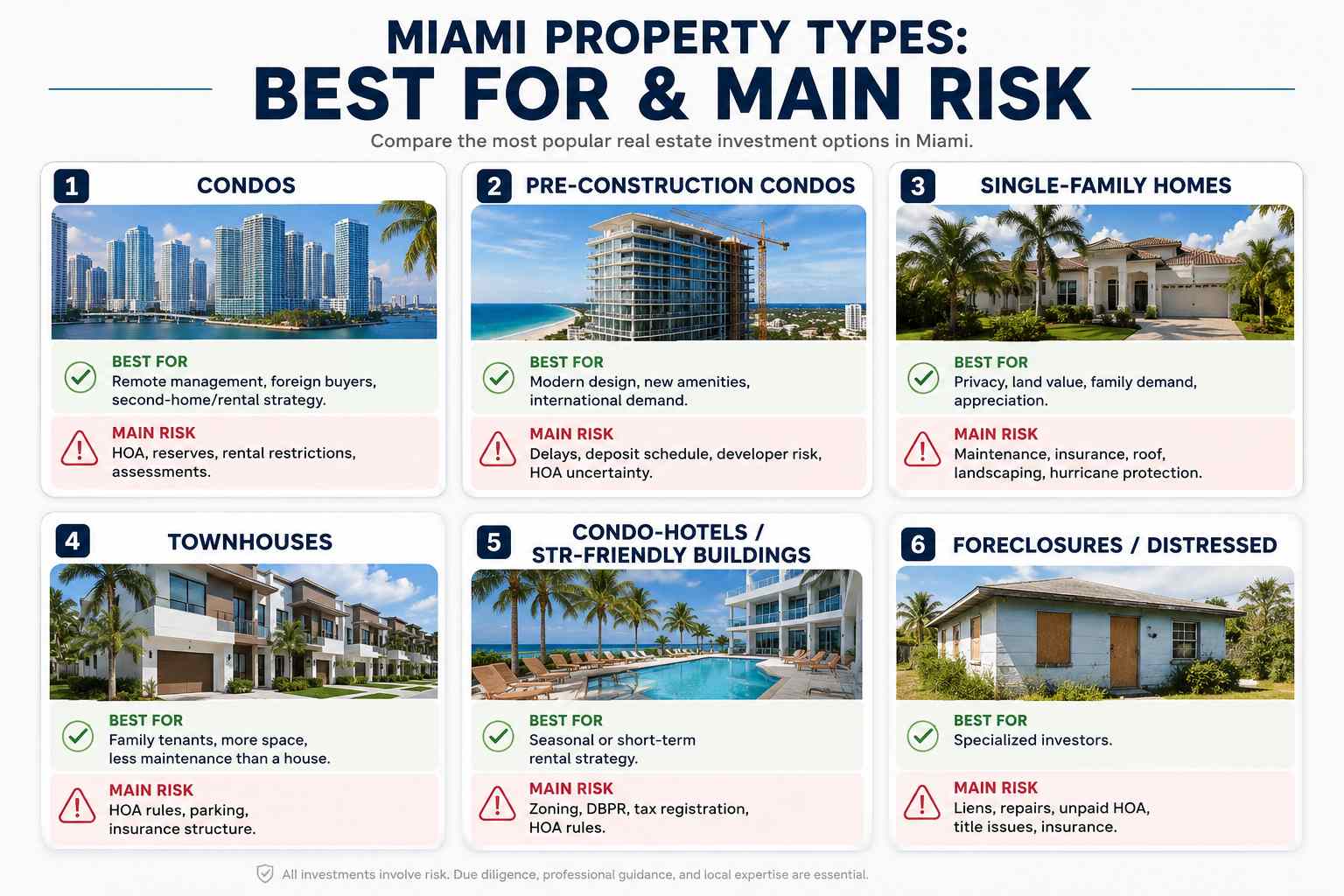
3. Condos
Miami apartments and condos are one of the most popular choices for investors, especially foreign buyers. Miami Florida condos are easier to manage remotely than single-family homes, often come with amenities, and are usually located in walkable areas near restaurants, offices, beaches, shops, and entertainment.
Buying a condo in Miami can make sense for rental, second-home, or long-term resale strategies. But the building is critical. Two condos in the same neighborhood can perform very differently if one building is financially healthy and investor-friendly while the other has high assessments, weak reserves, strict rental limits, aging systems, or unresolved litigation.
For a Miami condo investment, review HOA fees, reserves, litigation, insurance, rental restrictions, minimum lease terms, owner-occupancy ratios, pet rules, building age, upcoming repairs, milestone inspections, structural reserve studies, and special assessments.
4. New Construction and Pre-Construction Condos
New construction condos in Miami can be attractive because they offer modern design, new amenities, branded concepts, stronger lifestyle appeal, and the possibility of value growth before completion. They are especially popular with international buyers.
MIAMI REALTORS reported that international buyers purchased 49% of new South Florida construction, pre-construction, and condo conversion sales over an 18-month period ending in July 2025.
The advantages are clear: newer systems, modern layouts, stronger amenity packages, and less immediate repair risk. The risks are also real: construction delays, developer reputation, deposit schedule, financing changes, final closing costs, market shifts before delivery, and HOA rules that may not be fully clear until the building operates.
5. Single-Family Homes and Villas
Houses in Miami are usually better for buyers who want land, privacy, long-term appreciation, family rental demand, or more control over the property. They may have fewer HOA restrictions unless located in a gated community.
The tradeoff is cost. Insurance, landscaping, repairs, pool maintenance, roofing, hurricane protection, and general upkeep can be significant. A house can be a strong long-term asset, but it is rarely passive.
Single-family homes may be especially relevant for buyers focused on Coral Gables, Coconut Grove, parts of Miami Beach, Pinecrest, Key Biscayne, or other established residential areas where land, privacy, and school access can support long-term demand.
6. Townhouses
Townhouses in Miami can be a useful middle ground between condos and single-family homes. They usually offer more space than condos and less maintenance than detached homes.
For investors, townhouses may work well for families, long-term tenants, or buyers who want a residential feel without managing a full house. The key is to check HOA rules, parking, maintenance responsibilities, insurance structure, and rental restrictions.
7. Condo-Hotels and Short-Term-Rental-Friendly Buildings
Many investors come to Miami with one idea: "I’ll buy a condo and put it on Airbnb." That can be possible in some buildings and locations, but it is never something to assume.
Miami-Dade County states that vacation rentals must be licensed by the State of Florida, registered with the Florida Department of Revenue for tax purposes, and compliant with applicable state laws. The county also notes that transient accommodations or short-term rentals for six months or less require tax registration.
The City of Miami also makes clear that single-family homes and duplexes in T3 and T4-R transect zones are generally not eligible for short-term rental or lodging use.
That means short-term rental rules in Miami are not just a platform decision. The investor must check city rules, county requirements, DBPR licensing, tax registration, building documents, HOA bylaws, zoning, and insurance.
8. Foreclosed Homes and Distressed Properties
Foreclosed homes Miami FL searches usually come from investors looking for a discount. Sometimes there is an opportunity, but the discount can disappear quickly if the property has title issues, liens, unpaid assessments, structural problems, old systems, code violations, or insurance challenges.
In the current Miami market, foreclosure should be treated as a specialized strategy, not as the default path to a good deal.
Best Miami Areas for Real Estate Investment by Strategy
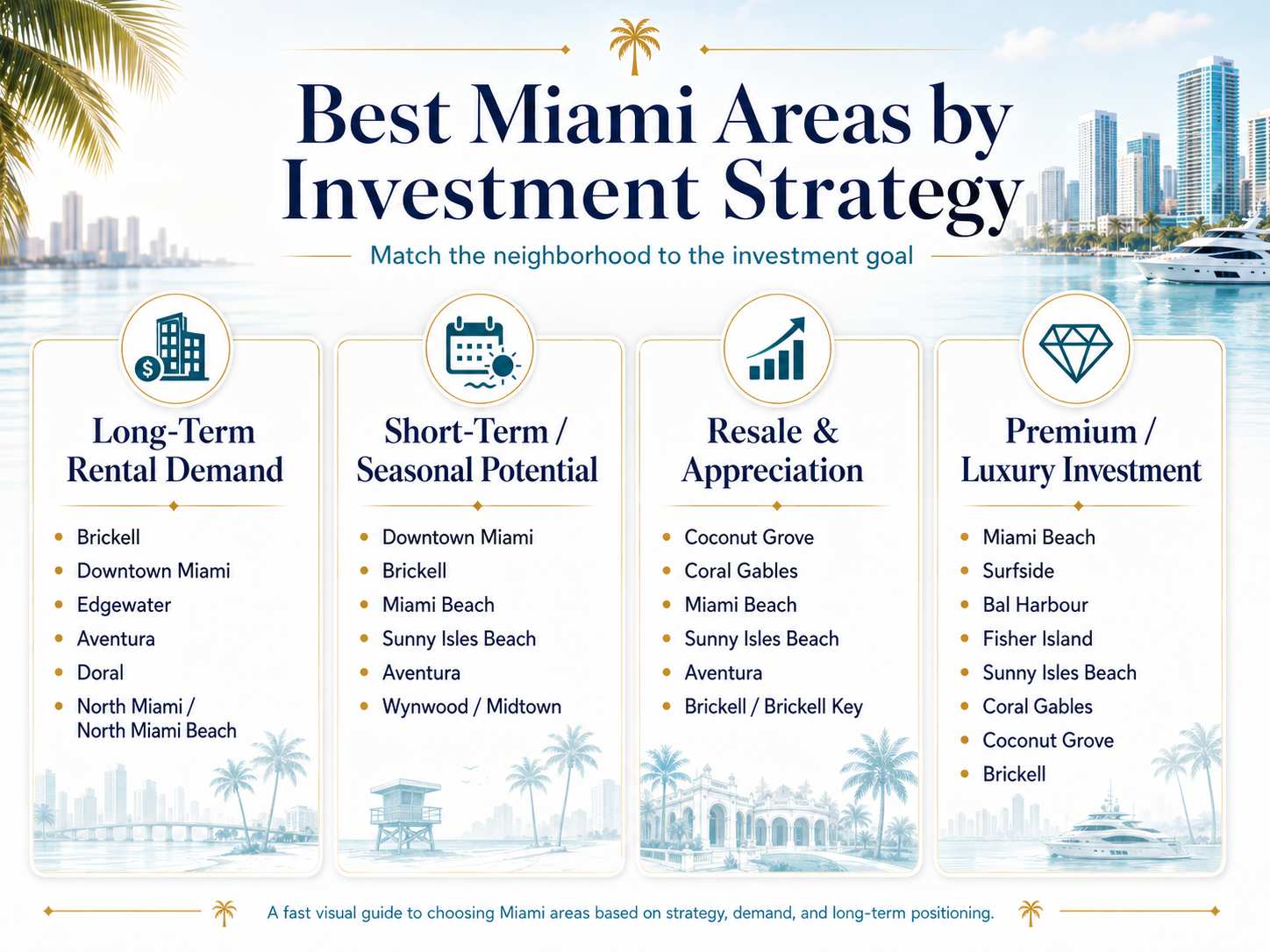
The best neighborhoods to invest in Miami depend on the strategy. A luxury second-home buyer, a long-term rental investor, and a buyer seeking capital preservation should not always look in the same place.
Best Areas for Long-Term Rental Demand
Brickell can work for investors targeting professionals who want an urban lifestyle, walkability, restaurants, offices, financial-district access, and high-rise condo living. The risk is that HOA fees, parking, and building rental rules can vary widely.
Downtown Miami may be relevant for investors looking at urban condo demand, access to business districts, entertainment, transit, and event-driven activity. The building policy matters because not every Downtown building works for the same rental strategy.
Edgewater can appeal to renters and buyers who want waterfront high-rise living, proximity to Wynwood, Midtown, Design District, and Downtown. Investors should compare view lines, building age, HOA costs, and future construction nearby.
Aventura often fits buyers and tenants who want shopping, schools, parks, a more residential lifestyle, and access to both Miami-Dade and Broward. It may work well for long-term tenants and second-home buyers, depending on the building.
Doral and business-linked demand. It is not the same type of luxury-waterfront market as Miami Beach or Sunny Isles, but it can be attractive for buyers who want newer communities, schools, and access to business corridors.
North Miami and North Miami Beach may offer a more accessible entry point compared with prime coastal areas. However, building selection is especially important. Investors should be careful with older condos, insurance, reserves, assessments, and rental policy.
Best Areas for Short-Term or Seasonal Rental Potential
Downtown Miami and Brickell may attract short-term or seasonal rental interest because of business travel, events, restaurants, and urban amenities. But zoning and building rules must be verified before purchase.
Miami Beach can attract strong vacation demand, but it has strict short-term rental rules. Miami Beach states that vacation and short-term rentals are prohibited in all single-family homes and in many multi-family housing buildings in certain zoning districts.
Sunny Isles Beach and Aventura may be more relevant for seasonal, luxury vacation, or longer-term international use, depending on the building. Many buyers in these areas are not only chasing rent; they also want personal use, ocean proximity, and resale appeal.
Wynwood and Midtown can attract lifestyle and event-driven demand, but investors must be especially careful with zoning, building rules, noise, parking, and management.
⚠️ Important!
Short-term rentals in Miami are not just a “platform decision.” The investor must check city rules, county rules, DBPR license, tax registration, building documents, HOA bylaws, zoning, minimum lease terms, insurance, and operational requirements.
Best Areas for Resale and Appreciation
Coconut Grove is often associated with greenery, privacy, schools, walkability, marina access, and a village-style luxury lifestyle. It can fit buyers who want long-term appreciation and strong lifestyle fundamentals.
Coral Gables offers established residential prestige, historic character, schools, tree-lined streets, and long-term buyer recognition. It may fit buyers looking for stability, family demand, and single-family home appreciation.
Miami Beach remains one of the strongest lifestyle brands in South Florida. It can fit buyers who want ocean proximity, iconic architecture, luxury condos, waterfront homes, and global recognition.
Sunny Isles Beach attracts international and luxury condo buyers who want oceanfront towers, views, amenities, and high-rise coastal living.
Aventura can fit buyers who want a residential environment, shopping, schools, parks, and long-term usability for families and seasonal owners.
Brickell and Brickell Key appeal to buyers who want high-rise urban living with financial-district access. Brickell Key adds a more private island feel while staying close to the center of Miami.
Best Areas for Premium and Luxury Investment
For Miami luxury real estate, investors often look at Miami Beach, Surfside, Bal Harbour, Sunny Isles Beach, Fisher Island, Coral Gables, Coconut Grove, Brickell, Brickell Key, and Aventura.
Luxury real estate Miami Florida buyers tend to focus on views, privacy, waterfront access, building services, brand, security, floor plan, ceiling height, parking, wellness amenities, marina access, and long-term resale appeal.
In the luxury segment, location matters, but micro-location matters even more. A direct ocean view, protected view corridor, private elevator, better stack, wider terrace, stronger building management, or lower future assessment risk can matter more than a small discount.
Is New Construction in Miami a Good Investment?
New construction in Miami can be a good investment when the location, developer, floor plan, view, delivery timeline, deposit schedule, and exit strategy all align with the buyer’s goals. It is not automatically a good investment simply because the property is new.
The benefits are real. New developments typically offer modern building systems, contemporary design, upgraded amenities, lower short-term maintenance requirements, and strong appeal among international buyers. Branded residences and luxury towers may also benefit from greater name recognition and stronger resale visibility.
The risks are equally important to evaluate. Construction timelines can be delayed. Deposits are often tied up throughout the development period. Developer reputation plays a significant role in the outcome of the investment. Closing costs may be higher than expected, HOA fees can change once the building becomes fully operational, and rental restrictions may not align with the investor’s original strategy.
Pros of New Construction
- Modern building systems
- Strong amenities
- Better appeal for foreign buyers
- Potential appreciation before delivery
- Branded residences and luxury services
- Less immediate repair risk
- More efficient layouts and newer design standards
Risks of New Construction
- Construction delays
- Deposit locked during construction
- Developer reputation risk
- Final closing costs
- Market shift before completion
- HOA fees not fully predictable before operation
- Rental rules may differ from early buyer expectations
- Resale competition if many similar units close at the same time
Tell us your budget and goals, and we will prepare a private shortlist of reliable new construction properties in Miami with attractive purchase terms.

Luxury Miami Real Estate as an Investment
Luxury Miami real estate deserves its own strategy. This market is driven by different buyer behavior than the entry-level or mid-market segments.
Luxury buyers often choose Miami for oceanfront scarcity, waterfront homes, branded residences, privacy, security, concierge service, wellness amenities, marinas, private elevators, and the ability to combine lifestyle with capital preservation.
Many luxury buyers are entrepreneurs, international families, buyers from high-tax U.S. states, and high-net-worth individuals who want both personal use and long-term liquidity.
The March 2026 market data supports the strength of this segment. Miami-Dade single-family sales at $1 million and above increased 19.83% year over year, and $1 million and above condo sales climbed 9.77%.
Luxury buyers should look beyond finishes. The strongest long-term assets usually have a combination of location, view, building reputation, privacy, service level, parking, floor plan, ceiling height, outdoor space, and scarcity.
A beautiful unit in the wrong building can be harder to resell than a more understated property in a prime, well-managed building.
Due Diligence Before Buying Miami Real Estate
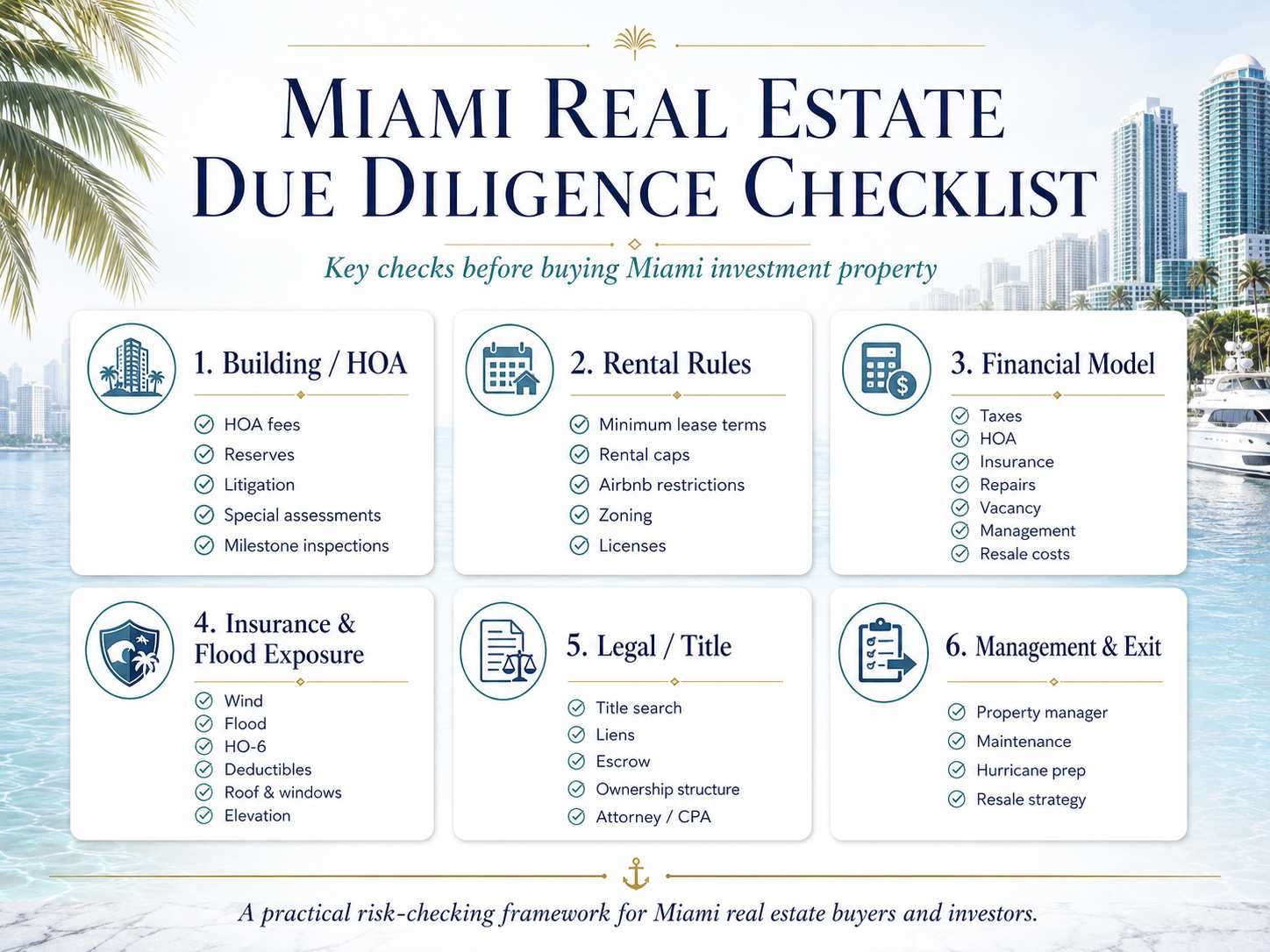
Due diligence is where Miami investments are won or lost. A property can look perfect online and still be a weak investment because of HOA restrictions, insurance costs, reserves, flood exposure, rental limits, or future special assessments.
Building and HOA Rules
For condos, the building matters as much as the unit. Investors should review HOA fees, reserves, special assessments, rental restrictions, minimum lease terms, pet rules, litigation, insurance, financial statements, building age, maintenance history, owner-occupancy ratio, and whether the building is investor-friendly.
Florida also has specific condominium safety requirements. The Florida DBPR condominium resource page explains that milestone inspections and structural integrity reserve studies are required by Florida law.
For older condo buildings, this is especially important. A lower purchase price may not be a bargain if the building faces major repairs, weak reserves, high insurance costs, or upcoming assessments.
Rental and Airbnb Restrictions
Never buy a Miami condo for Airbnb based only on a seller’s statement, agent comment, or online listing description. Verify the use through official zoning rules, county requirements, city procedures, DBPR licensing, tax registration, HOA documents, and building management.
A building can be in a desirable rental area and still prohibit short-term rentals. Another building may allow rentals but require 30-day, 90-day, six-month, or one-year minimum stays. These rules can completely change the investment math.
Financial Costs Investors Often Underestimate
Investors often focus on purchase price and expected rent. That is not enough.
A realistic Miami real estate investment model should include:
- closing costs;
- property taxes;
- HOA fees;
- insurance;
- flood insurance;
- repairs;
- furnishings;
- vacancy;
- property management;
- maintenance;
- special assessments;
- utilities;
- cleaning;
- licensing;
- accounting;
- resale costs.
Miami-Dade property values are determined as of January 1 each year, so investors should not assume that the previous owner’s tax bill will be the same after purchase.
Insurance, Flood Zone, and Climate Exposure
Insurance is one of the most important due diligence items in Miami. Investors should check wind coverage, flood insurance, building master policy, HO-6 condo coverage, deductibles, roof condition, windows, elevation, drainage, storm-surge exposure, and future premium risk.
FEMA states that the Flood Map Service Center is the official online location for flood hazard mapping products. Miami-Dade County also provides flood zone map tools and advises property owners to confirm official flood zone designation through the county or an insurance agent.
The Florida Office of Insurance Regulation notes that HO-6 condo policies usually do not cover flooding, so additional flood coverage may be needed if flood insurance is desired.
Foreign Buyers and Out-of-State Investors: What Is Different?
Foreign buyers and out-of-state investors can purchase Miami real estate, but the process should be planned and structured carefully. Cash purchases are common, but financing may also be available depending on the buyer’s profile, documentation, lender requirements, down payment, and country of residence.
The purchase process typically involves proof of funds, escrow, a title search, property inspections, condominium document review, insurance quotes, closing documentation, and fund transfers. Many buyers can complete much of the process remotely, but they still need trusted local representation on the ground.
For foreign buyers, timing is especially important. International wire transfers, bank compliance procedures, currency exchange, notarized documents, and lender requirements can take longer than expected. Buyers should have proof of funds prepared before submitting an offer, not after a property is already under contract.
Ownership structure should also be discussed with a CPA and attorney. Some buyers choose to purchase property in their personal name, while others consider an LLC or another ownership structure. The right approach depends on liability considerations, estate planning, tax reporting, financing requirements, privacy concerns, and long-term resale goals.
Property management should be considered before closing as well. A foreign buyer who plans to use the property only a few times per year needs a clear strategy for maintenance, access, repairs, mail handling, insurance, hurricane preparation, utilities, rentals, cleaning, and tax reporting .
Foreign buyers should also understand one important point: buying property in Miami does not automatically provide immigration status or residency rights in the United States. USCIS explains that the EB-5 Immigrant Investor Program requires an investment in a qualifying commercial enterprise and the creation of jobs. Purchasing a personal residence does not satisfy those requirements.
Step-by-Step: How to Invest in Miami Real Estate Safely
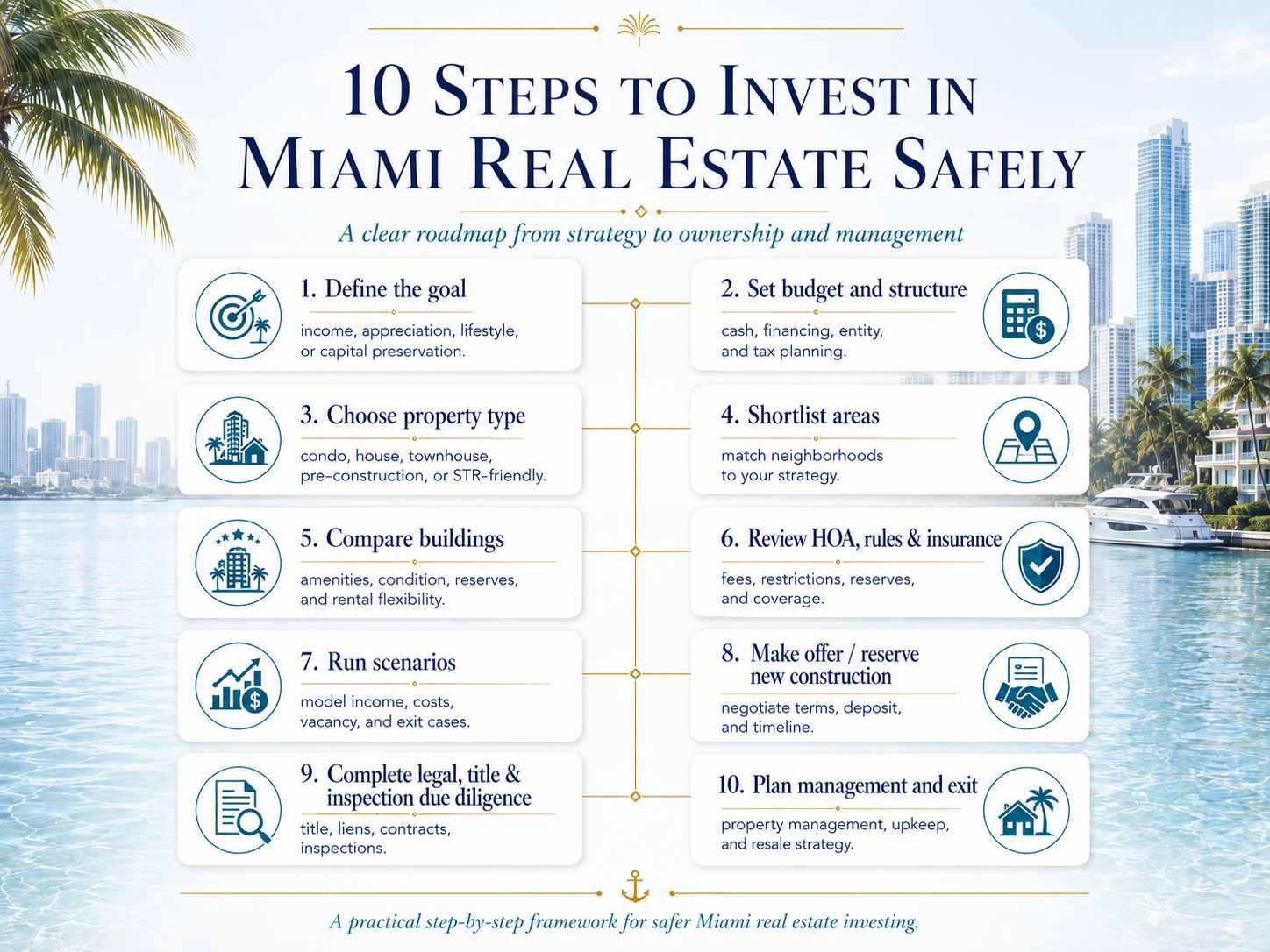
1. Define the Goal
Start with the investment goal: rental income, resale, lifestyle, relocation, luxury preservation, or a mix of strategies. Without this step, it is easy to compare the wrong properties.
2. Set the Budget and Purchase Structure
Decide whether the purchase will be cash or financed. Include closing costs, taxes, HOA, insurance, furnishings, reserves, and management costs in the budget.
3. Choose the Property Type
Compare condos, new construction, single-family homes, townhouses, condo-hotels, and luxury residences. Each property type has a different risk profile.
4. Shortlist Areas by Strategy
Do not choose an area only because it is popular. Choose it because it fits the strategy. Brickell may fit urban rental demand. Coral Gables may fit long-term family appeal. Sunny Isles may fit oceanfront luxury. Doral may fit family and business-linked demand.
5. Compare Buildings, Not Only Neighborhoods
In Miami, two buildings on the same street can have completely different rental rules, HOA costs, reserves, insurance, assessments, and resale liquidity.
6. Review HOA, Rental Rules, Insurance, and Reserves
Before moving forward, review condo documents, building financials, rental policies, insurance structure, inspection history, and any planned assessments.
7. Run Three Scenarios
A serious investor should model at least three scenarios:
- conservative;
- base case;
- optimistic.
Include vacancy, repairs, insurance changes, tax changes, and resale costs.
8. Make an Offer or Reserve New Construction Carefully
For resale properties, understand the inspection period and contract contingencies. For pre-construction, review the deposit schedule, developer reputation, delivery timeline, and closing cost expectations.
9. Complete Legal, Title, Inspection, and Insurance Due Diligence
Work with the right local professionals before closing. This is especially important for foreign buyers, older condos, waterfront properties, and short-term rental strategies.
10. Plan Management and Exit Before Closing
Decide who will manage the property, how it will be maintained, whether it will be rented, and what the likely exit strategy is.
Common Mistakes Miami Real Estate Investors Should Avoid
The most common mistake is buying based only on the neighborhood. In Miami, the building can matter more than the ZIP code.
Other common mistakes include:
- assuming every Miami condo can be rented short-term;
- ignoring HOA reserves and special assessments;
- underestimating insurance and maintenance costs;
- buying older condos without checking inspections;
- focusing only on price per square foot;
- ignoring flood zone and wind insurance exposure;
- not checking minimum lease terms;
- buying new construction without reviewing developer risk;
- confusing a lifestyle purchase with an investment purchase;
- entering the market without a clear exit strategy.
A property can be emotionally perfect and financially average. That does not make it wrong, but the buyer should know which goal matters most.
FAQ Miami Real Estate Investment
Is Miami real estate a good investment in 2026?
Miami real estate can be a good investment in 2026 when the buyer chooses the right property type, building, area, and strategy. Single-family homes, condos, luxury properties, and new construction all have different risk profiles. The strongest investments are usually supported by clear due diligence, realistic cost modeling, and a defined exit plan.
What is the best type of property to invest in Miami?
There is no single best property type for every investor. Condos may work well for foreign buyers and second-home strategies. Single-family homes may fit long-term appreciation and family demand. New construction can appeal to buyers seeking modern amenities and future resale potential. Luxury properties may suit capital preservation and lifestyle-focused buyers.
Are condos in Miami good for investment?
Condos can be good investments, but only when the building is financially healthy and the rental rules match the strategy. Investors should review HOA fees, reserves, special assessments, insurance, rental restrictions, minimum lease terms, building age, milestone inspections, and resale liquidity before buying.
What are the best Miami neighborhoods for real estate investment?
The best neighborhoods depend on the investment goal. Brickell, Downtown Miami, Edgewater, Aventura, Doral, North Miami, and North Miami Beach may fit long-term rental demand. Coconut Grove, Coral Gables, Miami Beach, Sunny Isles Beach, Aventura, Brickell, and Brickell Key may fit resale and appreciation strategies. Luxury buyers often consider Miami Beach, Bal Harbour, Surfside, Fisher Island, Sunny Isles, Coral Gables, Coconut Grove, and Brickell.
Is buying a condo in Miami better than buying a house?
A condo may be easier to manage remotely and can offer amenities, location, and rental potential. A house usually offers more control, land value, privacy, and long-term family appeal. The better choice depends on budget, management plan, maintenance tolerance, financing, insurance, and investment goal.
Can foreigners buy real estate in Miami?
Foreign buyers commonly purchase Miami real estate. Many buy with cash, while others use foreign-national mortgage programs. The buyer should plan for proof of funds, title, escrow, taxes, insurance, currency transfer, ownership structure, and property management. Legal and tax advice is important.
Can I rent out my Miami condo on Airbnb?
Sometimes, but not always. Short-term rental rules depend on city zoning, county requirements, state licensing, tax registration, HOA bylaws, and building rules. Never assume Airbnb use is allowed just because the property is in Miami.
Is Miami luxury real estate a good investment?
Miami luxury real estate can be attractive for buyers who value scarcity, waterfront access, privacy, branded residences, international demand, and long-term capital preservation. It is not a guaranteed return strategy. Building reputation, view, location, service level, and resale liquidity are critical.
Should I buy new construction in Miami?
New construction can be attractive if the developer, location, floor plan, view, delivery schedule, deposit structure, and exit strategy are strong. The risks include construction delays, changing market conditions, locked deposits, closing costs, and HOA uncertainty before the building is fully operational.
What are the biggest risks of investing in Miami real estate?
The biggest risks include overpaying, buying in the wrong building, ignoring HOA rules, underestimating insurance, missing special assessments, assuming short-term rentals are allowed, overlooking flood exposure, failing to review condo documents, and not having a clear resale or management strategy.
- — Is Miami Real Estate a Good Investment in 2026?
- — Why Florida and Miami Attract Investors from the U.S. and Abroad
- — Miami vs Other Florida and U.S. Markets
- — Your Miami Real Estate Investment Strategy
- — The Most Popular Types of Miami Real Estate for Investment
- — Best Miami Areas for Real Estate Investment by Strategy
- — Is New Construction in Miami a Good Investment?
- — Luxury Miami Real Estate as an Investment
- — Due Diligence Before Buying Miami Real Estate
- — Foreign Buyers and Out-of-State Investors: What Is Different?
- — Step-by-Step: How to Invest in Miami Real Estate Safely
- — Common Mistakes Miami Real Estate Investors Should Avoid
- — FAQ Miami Real Estate Investment
Similar articles